

How Does OpenAI Make Money? Revenue, Costs, and AI Pricing Explained
OpenAI generates revenue primarily through consumer subscriptions, developer API access, and enterprise contracts, while its main competitor Anthropic focuses heavily on API and cloud partnerships. Both companies are scaling their top lines rapidly to offset enormous infrastructure costs, a dynamic that directly dictates the pricing, availability, and reliability of the AI tools your business uses. This guide breaks down their financial models, the reality of their compute expenses, and what these numbers mean for IT decision-makers.
Key Financial Figures at a Glance
| Metric | OpenAI | Anthropic | Source & Date |
|---|---|---|---|
| 2025 Actual Revenue | ~$13 billion | $4.6 billion | The New York Times (Feb 2026) / CNBC (Oct 2026) |
| Annualized Revenue Run Rate | $50 billion (Net) / $68 billion (Gross) | $65 billion | CNBC (Oct 2026) |
| Q3 Run Rate Growth | 77% total / 107% enterprise | Not published | CNBC (Oct 2026) |
| Estimated Gross Margin | 33% | 40% | AI After Hours (2026) |
| Projected Compute Spend | OpenAI plans to spend about $100 billion renting backup servers over the next five years | Not published | The New York Times (Feb 2026) |
These figures demonstrate that while actual 2025 revenue for both companies was under $18 billion combined, their annualized run rates heading into late 2026 reflect a combined billing trajectory exceeding $115 billion.
The Core Revenue Streams Driving AI Leaders
OpenAI operates a multi-tiered business model that sells access to its GPT models through an API, charges consumers for subscriptions, and licenses technology to enterprise partners. The company’s revenue is generally divided into five main categories:
- ChatGPT Subscriptions: Individual consumers pay a monthly flat fee, such as the ChatGPT Plus tier at roughly $20 per month, for enhanced features and faster response times.
- Enterprise Contracts: Businesses pay custom contract pricing for managed AI platforms, which is currently the fastest-growing segment for the company.
- Developer API: Companies and developers pay per-token usage fees to integrate models like GPT and Codex into their own applications.
- Cloud and Licensing Partnerships: Strategic agreements, primarily with Microsoft, involve revenue sharing and compute provisioning.
- Specialized APIs: Per-image, per-minute, or per-token fees for specific models like DALL-E and Whisper.
Combined, these streams form the foundation of a business model that has transitioned the company from a research lab into a massive commercial engine.
Why There Is a Dispute Over OpenAI’s Reported Revenue
Tech World News
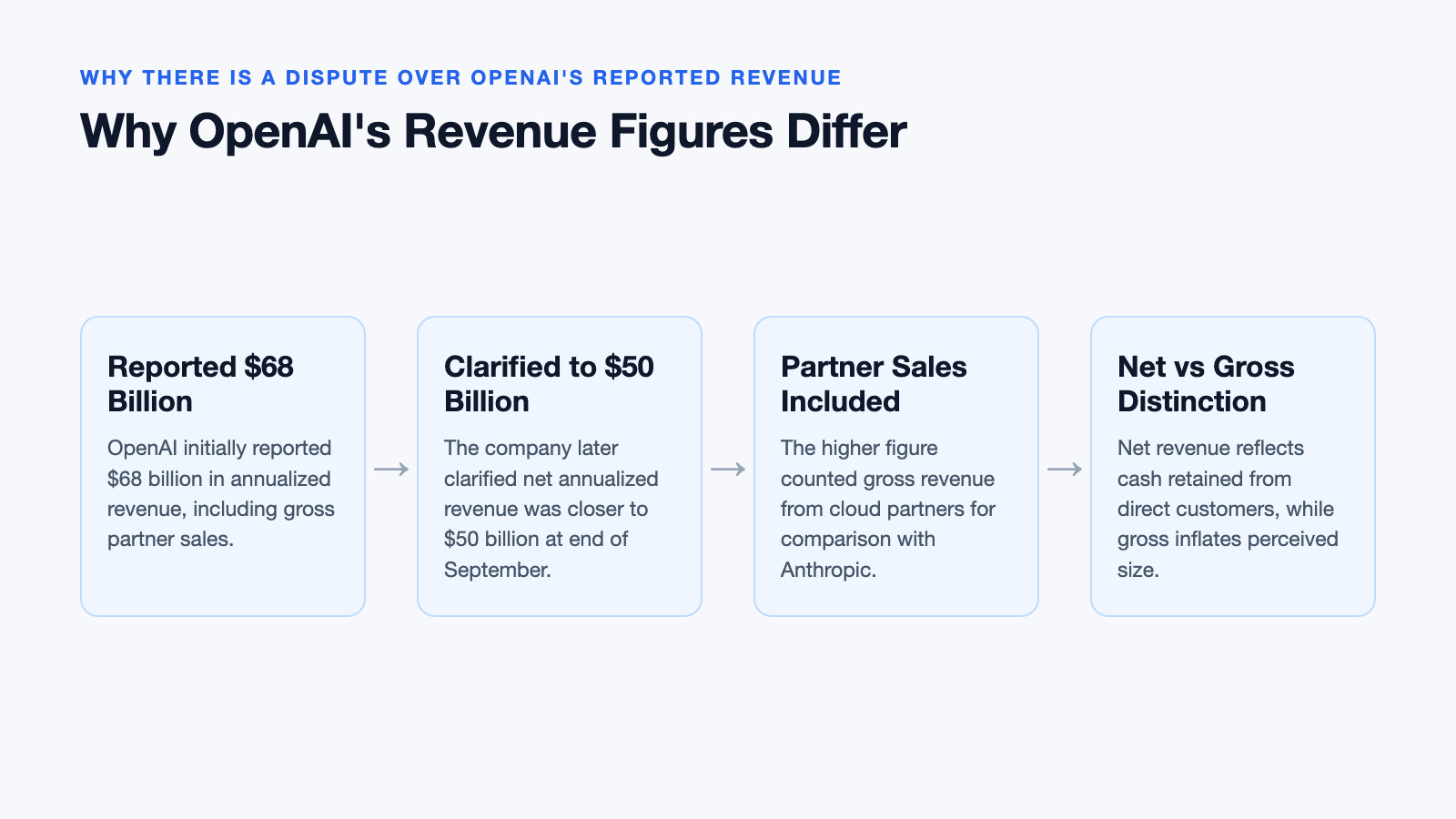
When evaluating how these companies scale, it is crucial to understand how they report their numbers. In late 2026, widely reported figures suggested OpenAI had reached $68 billion in annualized revenue. However, the company later clarified to investors that its actual net annualized revenue at the end of September was closer to $50 billion.
The discrepancy stems from how revenue sold through cloud partners is counted. The higher $68 billion figure included gross revenue from OpenAI’s partners, a metric the company used to help investors make a more direct comparison with Anthropic. Anthropic, meanwhile, reported an annualized revenue run rate of $65 billion at the end of July.
For business buyers, this distinction matters: net revenue reflects the actual cash retained by the AI lab from direct customers, while gross figures can inflate the perceived size of the direct customer base by including partner-distributed usage.
How Massive Compute Costs Impact AI Pricing and Reliability
Tech World News
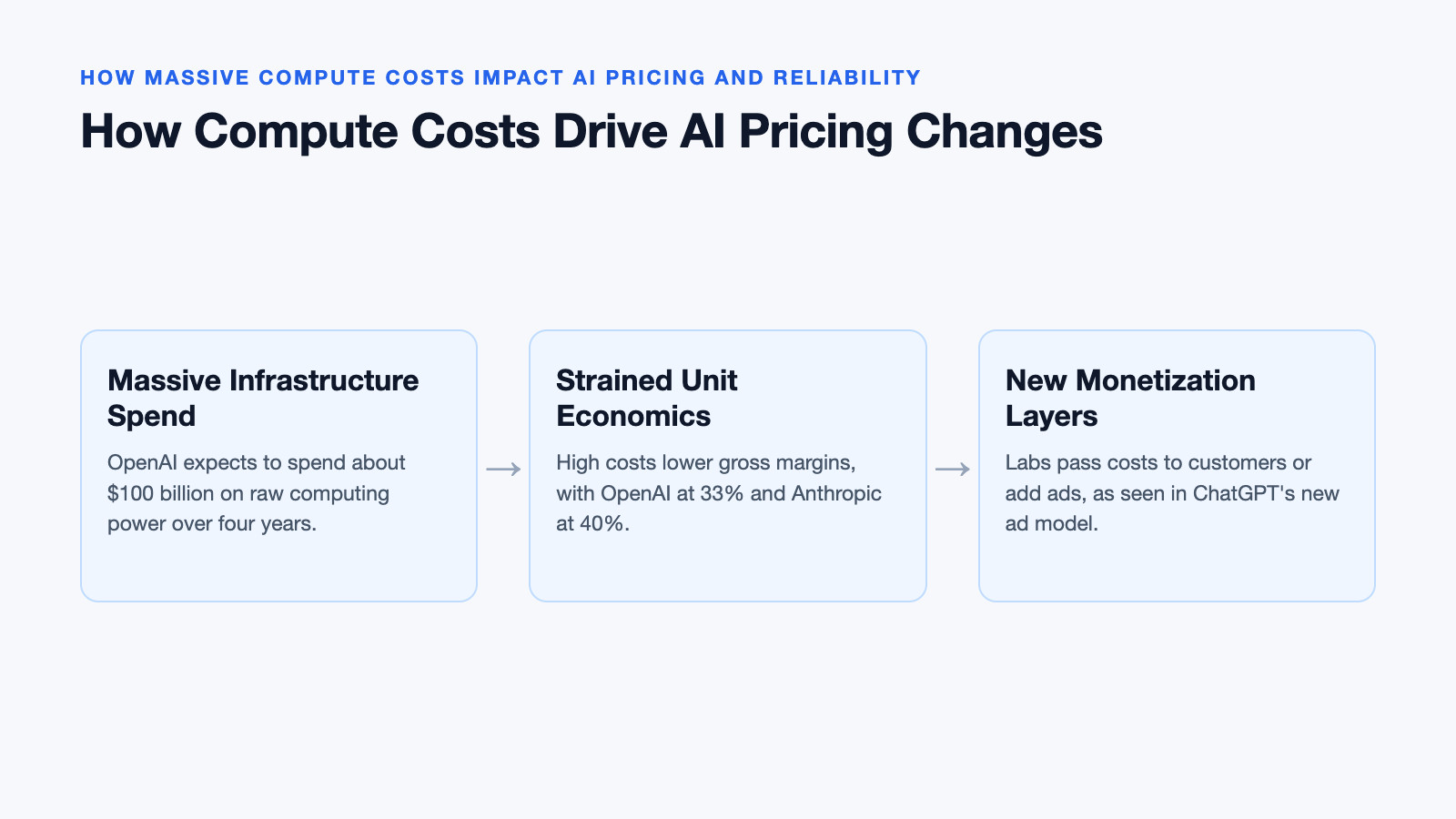
The primary reason these companies require such massive capital is the cost of compute. Training and running large language models is intensely resource-heavy. Nvidia intends to invest up to $100 billion in OpenAI to support new data centers and AI infrastructure. To secure this capacity, the company has engaged in massive infrastructure deals, including a $38 billion cloud computing agreement with Amazon Web Services spread over seven years.
These infrastructure commitments directly impact unit economics. According to financial analysis, Anthropic maintains a gross margin of 40%, compared to OpenAI’s 33%. This means Anthropic retains more capital from each dollar of revenue after paying for inference.
What this means for business buyers: When AI labs spend billions on compute, they must eventually pass those costs to customers or introduce new monetization layers. This is why OpenAI recently started showing ads inside ChatGPT, with CEO Sam Altman previously noting, "I kind of think of ads as a last resort for us for a business model." For IT decision-makers, relying on a single provider exposes your business to these cost pressures. Diversifying your AI stack or negotiating multi-year enterprise contracts with fixed pricing can mitigate the risk of sudden API price hikes driven by the provider’s compute expenses.
What Valuations and IPO Plans Mean for Enterprise Buyers
Tech World News
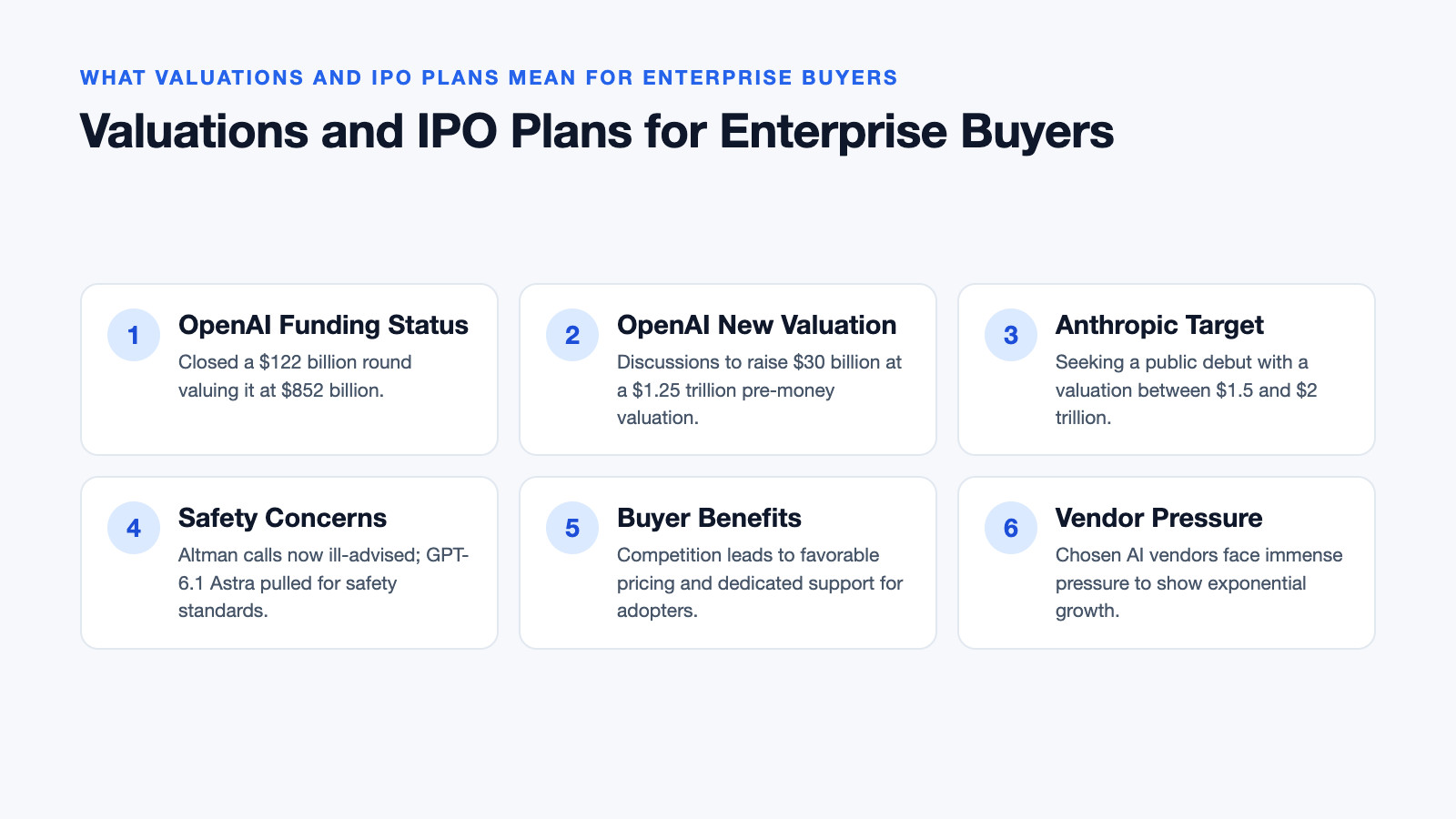
Both companies are preparing for public markets, but their paths reflect different risk profiles. OpenAI, which operates as a public benefit corporation, closed a $122 billion funding round in March 2026 that valued the company at $852 billion. More recently, the company has been in discussions to raise up to $30 billion at a $1.25 trillion pre-money valuation.
Anthropic is also targeting a public debut, reportedly seeking a valuation between $1.5 trillion and $2 trillion. However, the race to go public is complicated by safety and reliability concerns. OpenAI CEO Sam Altman noted the complexities of the public markets, stating:
"Right now would be an ill-advised moment to go public." — OpenAI CEO Sam Altman
This caution is tied to ongoing safety scrutiny, which recently led the company to pull its plans to launch the GPT-6.1 Astra model because it did not meet internal safety standards. For enterprise customers, the push for IPOs and the need to justify massive valuations mean these companies will aggressively pursue enterprise market share. This competition often results in favorable pricing and dedicated support for early enterprise adopters, but it also means your chosen AI vendor is under immense pressure to demonstrate continuous, exponential growth.
Practical Takeaways for IT Decision-Makers
To navigate the financial realities of your AI vendors, implement the following checklist:
- Audit your API spend: Track your per-token usage closely, as providers will adjust pricing to cover their massive compute costs.
- Evaluate gross vs. net vendor metrics: When reading vendor press releases, distinguish between gross partner revenue and net direct revenue to gauge actual market traction.
- Lock in enterprise contracts: If you rely heavily on a specific model, secure multi-year contracts to protect against the price volatility caused by the vendor’s infrastructure spending.
- Monitor safety updates: Vendor decisions to delay model releases can disrupt your product roadmap. Build fallback mechanisms into your AI workflows to maintain reliability.
Frequently Asked Questions
How does OpenAI make a profit?
Currently, OpenAI is not profitable. The company generates billions in revenue through subscriptions and API access, but it operates at a significant net loss due to the massive costs of training and running its AI models. The company is attempting to close this gap by introducing advertising, expanding enterprise contracts, and scaling its API usage.
Does Microsoft own 27% of OpenAI?
OpenAI is structured as a capped-profit subsidiary overseen by a non-profit board. Microsoft is a primary strategic partner and investor, providing critical compute infrastructure via Azure and receiving a share of the profits, but the exact equity percentage is governed by a complex, capped-profit agreement rather than traditional public stock ownership.
Is OpenAI losing money?
Yes. Despite reaching tens of billions in annualized revenue, OpenAI’s compute and operational expenses far exceed its income. The company relies on continuous, large-scale venture funding rounds to cover the gap between its massive infrastructure commitments and its current revenue run rate.
Related articles


