
Google Research@ 2026: Deploying Specialized AI for Clinical, Planetary, and Orbital Science
Google detailed its latest artificial intelligence milestones at the Research@ 2026 event in Mountain View on October 15, 2026, unveiling specialized models for clinical diagnostics, epidemiological forecasting, and orbital computing. The announcements mark a strategic transition from broad foundational model development to deploying targeted AI systems designed to solve specific healthcare and environmental challenges.
How Earth AI and Science AI Are Forecasting Public Health Crises
Google’s public health initiatives rely on two distinct AI models to overcome traditional data limitations in epidemiology. The Google Science AI model ranked first in predicting flu-related hospital admissions according to the Centers for Disease Control and Prevention.
Simultaneously, Google Earth AI introduced its Population Dynamics Foundation Model (PDFM) to address data gaps and temporal reporting lags inherent in standard public health workflows.
For public health officials and healthcare IT practitioners, this shift from reactive data aggregation to proactive geospatial forecasting has immediate operational implications. Resources can now be allocated to vulnerable communities before outbreak peaks occur, rather than after hospital capacity is already strained by delayed reporting metrics.
What The Lancet Study Reveals About the AMIE Clinical AI
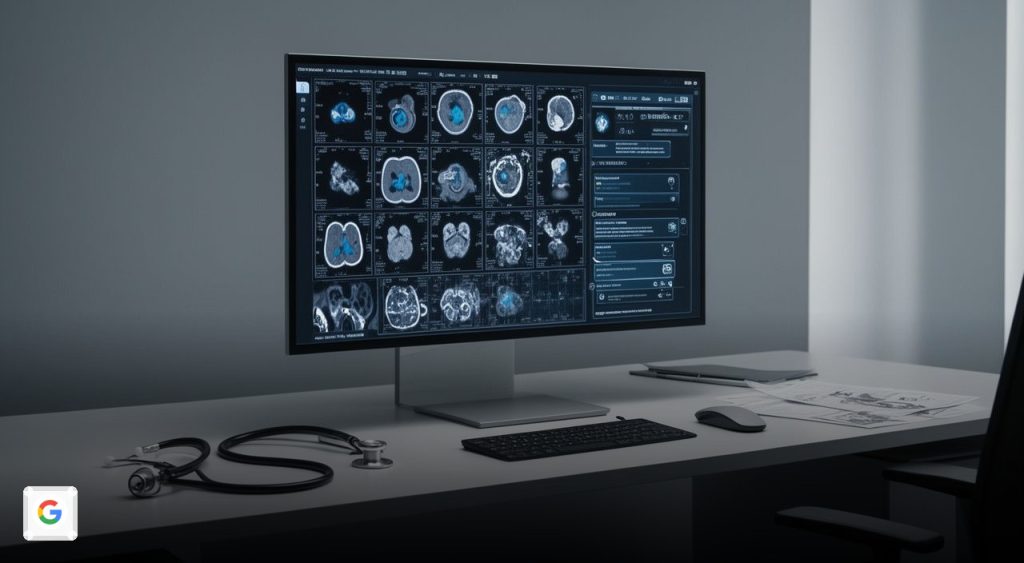
In the clinical space, Google published a peer-reviewed study in The Lancet evaluating the AMIE medical AI in a real-world primary care clinic. This deployment tests how AI can assist in complex diagnostic workflows and patient-doctor interactions without replacing human medical oversight.
Yossi Matias, VP and GM of Google Research, framed the broader initiative during the event:
"This is the golden age of research and scientific discovery. Today, more than ever, we can push the frontiers and ask the most audacious questions that can have transformative impact on products, science, and society."
Why Project Suncatcher Is Testing AI Hardware in Space
Expanding computing beyond terrestrial data centers, Project Suncatcher is an initiative to put AI in space. The project focuses on testing hardware survival for space environments and designing specialized cooling systems for AI chips in orbit.
While terrestrial data centers face physical and energy constraints, orbital AI processing could eventually allow for real-time analysis of Earth observation data. Processing the massive geospatial datasets used by Earth AI directly in orbit would eliminate the latency of transmitting raw data back to ground stations, enabling instantaneous environmental monitoring.
How the $30M Google.org Fund and Scholar Labs Accelerate Applied Science
To sustain this pipeline of applied research, Google.org launched a $30M global open-call through the Impact Challenge: AI for Science. The initiative targets nonprofits, social enterprises, and academic institutions working on AI for Health & Life Sciences and AI for Climate Resilience. Selected organizations receive six months of dedicated pro bono technical support from Google experts and access to Google Cloud credits.
In the academic research space, Google also introduced Scholar Labs, an experimental AI-powered platform designed to interpret intricate research questions from its database, as reported by GovTech. This tool aims to make advanced AI accessible to the broader scientific community for literature synthesis and data retrieval.
This funding and tooling mechanism directly supports what Google Research previously identified as the "Magic Cycle of research," a framework designed to accelerate the translation of foundational AI developments into real-world solutions. By pairing capital with direct technical expertise and specialized research platforms, Google is compressing the timeline between laboratory AI development and deployed scientific infrastructure.
The integration of orbital computing with terrestrial epidemiological models, supported by a $30M external funding pipeline, establishes a measurable framework for how foundational AI research transitions into deployed scientific infrastructure.
Related articles


