
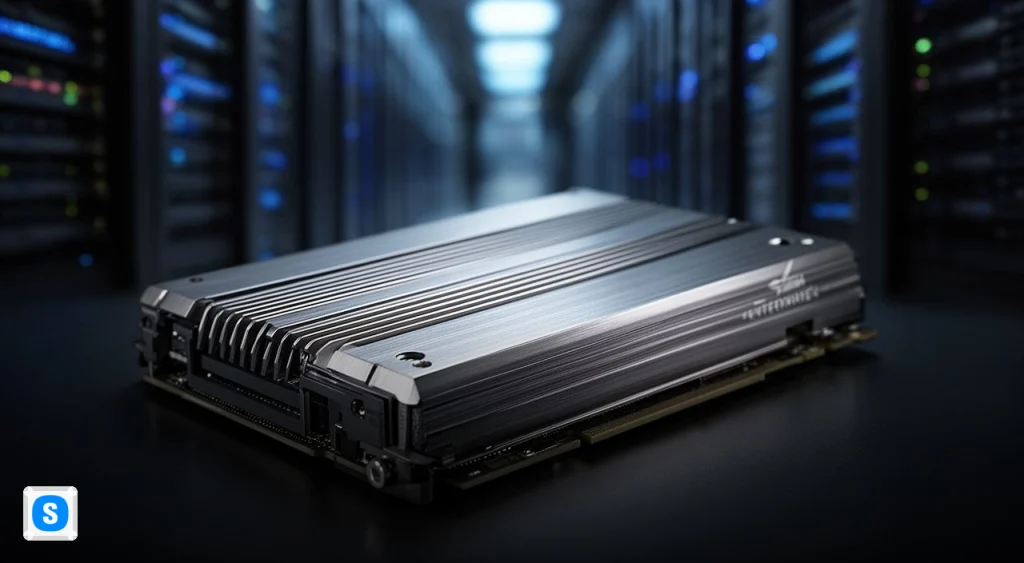
Samsung Expands Consumer SSD Campaign While Unveiling 256TB Enterprise Drives for AI
Samsung Electronics is expanding its "Choose the sure thing" out-of-home advertising campaign across prominent global landmarks in New York, London, and Hong Kong to promote consumer data reliability. However, alongside this consumer marketing push, the company simultaneously unveiled massive enterprise storage upgrades, including a 256TB solid-state drive designed specifically for next-generation AI data centers.
What the Samsung "Choose the Sure Thing" Campaign Promotes to Consumers
Samsung is deploying out-of-home advertising at locations including Times Square, Piccadilly Circus, and the Entertainment Building in Central. The campaign positions Samsung SSDs as a premium storage brand for everyday users and professionals managing personal or small business data.
Tommy (Hyoungsuk) Kwon, Vice President of Memory Brand Product Biz Team at Samsung Electronics, stated, "In an era where data is more critical than ever, losing it means losing everything".
This initiative follows previous consumer-focused efforts, such as the 2019 "Welcome to Solid State" digital campaign and the 980 NVMe SSD product testing program. Those earlier campaigns aimed to highlight speed and durability to mass audiences and PC enthusiasts, establishing a baseline of brand trust that the current global rollout seeks to reinforce.
How the Samsung P9 and P7 USB4 SSDs Serve Professional Creators
For professional users and IT teams managing media workflows, Samsung recently expanded its portable lineup with the P9 and P7 USB4 SSDs, as reported by Newsshooter, which detailed the P9 and P7 USB4 SSD specifications.
The P9 is Samsung’s first 8TB USB4 portable SSD. It delivers sequential read speeds of up to 4,000 MB/s and sequential write speeds of up to 3,800 MB/s. These speeds are approximately twice those of the previous generation, such as the 4TB Samsung T9, which maxed out at 2,000 MB/s over a USB 3.2 Gen 2×2 interface. The P-Series is available in 1TB, 2TB, 4TB, and 8TB capacities, catering directly to videographers and data-heavy creative workflows.
Why Samsung is Building 256TB and PCIe 6.0 Drives for AI Infrastructure
While consumer campaigns focus on data peace of mind, Samsung’s engineering resources are heavily directed toward AI infrastructure. During the Global Memory Innovation Forum 2026 in Shenzhen, Samsung introduced the BM1773 and PM1763 enterprise drives, according to SamMobile, which covered the BM1773 and PM1763 enterprise drive introductions.
The BM1773 is an ultra-high-density QLC SSD available in capacities reaching up to 256TB within a compact E3.S form factor. It leverages Samsung’s 9th-generation high-density NAND flash across a 16-channel PCIe 5.0 architecture.
Simultaneously, Samsung showcased V10 NAND with over 400 layers and zNAND-O, a technology specifically targeting on-device AI processing, as noted by SammyGuru regarding the V10 NAND and zNAND-O technologies. The PM1763 brings PCIe 6.0 speeds to optimize next-generation AI server environments.
What IT Leaders Should Expect from Samsung’s Enterprise Storage Roadmap
For IT decision-makers evaluating storage for AI workloads, the divergence between Samsung’s consumer messaging and its enterprise hardware reveals a dual-track strategy. The consumer side prioritizes reliability and brand trust, while the enterprise side prioritizes extreme density and bandwidth to feed AI training clusters.
Here is a breakdown of Samsung’s latest storage capabilities across consumer and enterprise tiers:
| Product Line | Target Use Case | Max Capacity | Interface / Architecture | Key Performance Metric |
|---|---|---|---|---|
| P9 Portable SSD | Professional Media / Creators | 8TB | USB4 | 4,000 MB/s read |
| BM1773 Enterprise | AI Data Centers / High-Capacity | 256TB | PCIe 5.0 (16-channel) | Ultra-high density QLC |
| PM1763 Enterprise | Next-Gen AI Infrastructure | Not published | PCIe 6.0 | Optimized for AI workloads |
The introduction of zNAND-O for on-device AI indicates that Samsung is preparing for a shift where storage must interact directly with processing units at the edge, rather than just sitting passively in a data center rack. IT managers planning AI deployments should note that future hardware procurement will need to account for these memory-processing integrations, not just raw terabyte counts.


