
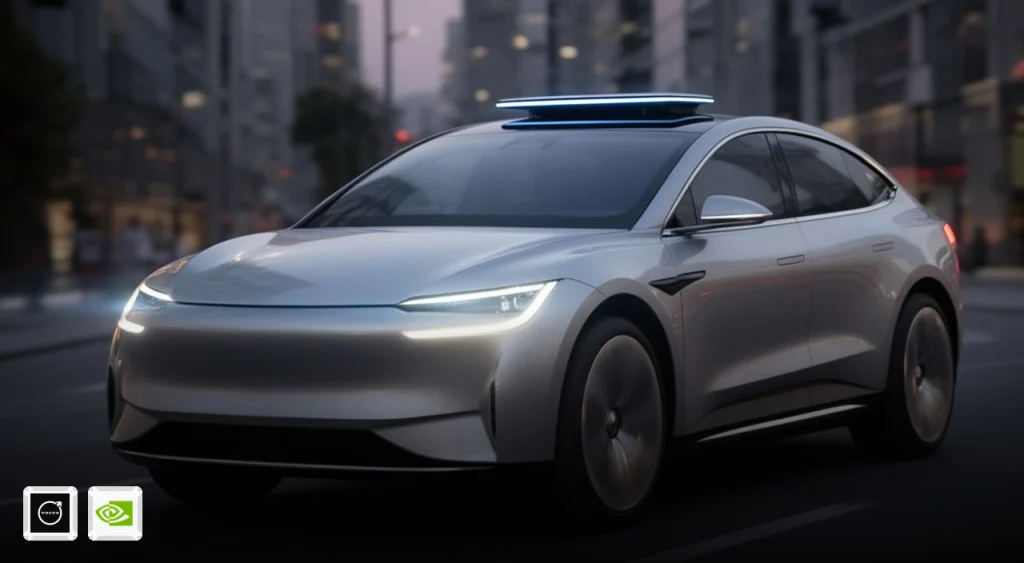
Volvo Cars and NVIDIA Expand Automated Driving Partnership for Next-Generation Software-Defined Vehicles
Volvo Cars is expanding its decade-long partnership with NVIDIA to integrate advanced automated driving technologies into its next-generation vehicles, targeting door-to-door autonomous navigation. The collaboration combines Volvo’s safety engineering with NVIDIA’s Hyperion architecture, Halos OS, and Alpamayo Stack, marking a significant step toward hands-free driving capabilities before 2030.
What the NVIDIA Hyperion Architecture and Alpamayo Stack Will Power in Volvo Cars
Volvo Cars will integrate NVIDIA’s Hyperion sensor and compute architecture, alongside the Halos OS and Alpamayo Stack driving software. This comprehensive technology stack is designed to navigate complex real-world environments, processing data to handle everything from highway cruising to busy urban streets and tight parking scenarios.
Alwin Bakkenes, Volvo Cars’ head of software engineering, noted that the first deployment will focus on supervised driving features, meaning drivers will remain responsible for the vehicle during the initial rollout. The company’s long-term ambition is to gradually introduce more advanced capabilities, including hands-free driving in urban areas and on highways, eventually moving toward eyes-off and mind-off operation.
"Accelerated computing has transformed the car into an intelligent machine that can understand the world around it." — Jensen Huang, founder and CEO of NVIDIA
How Volvo Cars and NVIDIA Evolved From DRIVE Orin to a Full Tech Stack
This expanded agreement builds on a foundational relationship that began in 2017, when Autoliv, Volvo Cars, and Zenuity initially teamed up with NVIDIA to develop advanced systems for self-driving cars. The collaboration soon broadened, with the Volvo Group partnering with NVIDIA in 2019 to develop decision-making systems for autonomous commercial vehicles and machines.
For the consumer automotive side, the hardware transition accelerated with the EX90, which introduced the NVIDIA DRIVE Orin system-on-a-chip capable of “250 trillions of operations per second (TOPS)”. Looking ahead, Volvo plans to integrate the NVIDIA DRIVE Thor, which delivers up to 1,000 TOPS and seven times greater energy efficiency.
This hardware evolution reflects a broader operational shift within the automaker. "Automakers used to be very much like car-line based development… and we have completely changed and migrated into being a full tech stack company," Bakkenes told TechCrunch, highlighting the transition from relying on fragmented suppliers to building centralized, software-defined architectures.
Why Volvo Cars is Accelerating Its Automated Driving Push Against Tesla and BMW
The timing of this expansion is driven by intense competitive pressure in the autonomous vehicle sector. Automakers including Mercedes-Benz, BMW, and Ford are actively targeting more advanced automated-driving systems, ranging from hands-free highway driving to limited-condition self-driving operations. Concurrently, Tesla is pushing for “broader approval of its assisted-driving technology in Europe”, with an EU-wide regulatory vote anticipated in December 2026.
For Volvo, maintaining its century-old brand identity requires merging its human-centric safety research with modern AI. Håkan Samuelsson, president and CEO of Volvo Cars, stated that the partnership brings together "industry-leading safety knowledge and world-class AI technology" to create safer, more attractive vehicles. This strategic alignment supports Volvo’s broader electrification goals, following a year where the company sold over 710,000 cars with a 46% electrified share in 2025.
What to Watch for in Volvo Cars’ Autonomous Driving Rollout Before 2030
As Volvo prepares to deploy this new technology, several specific milestones and strategies will define its market impact:
- Deployment Timeline and Geography: The new automated driving technology will appear in Volvo vehicles before 2030. The initial launch will occur in multiple regions simultaneously, explicitly excluding China in the first phase.
- Pricing and Accessibility: Volvo has not yet finalized a pricing model for these software features. However, Bakkenes indicated that the technology “would not just be available for higher-priced models”, according to Investing.com.
This democratization of advanced autonomous features across the fleet, rather than restricting them to premium trims, will be a critical factor in determining Volvo’s market share against legacy rivals and new EV entrants.
Related articles


