NVIDIA DSX Pod and Platform Updates Target Data Center Power and Cooling Bottlenecks
NVIDIA has introduced the DSX Pod AI Factory, a containerized modular data center unit, alongside expanded software tools designed to integrate AI compute directly with power grid infrastructure. Announced at GTC Berlin, the platform aims to eliminate the physical and electrical constraints that currently delay large-scale AI deployments, reducing site activation from six months to just 14 days.
How the NVIDIA DSX Pod Accelerates Hardware Deployment
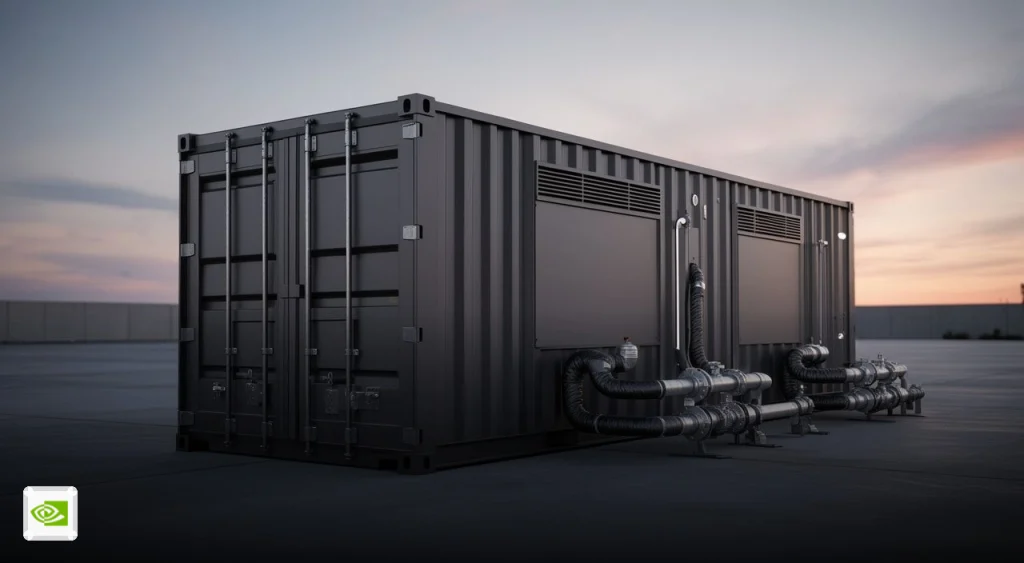
NVIDIA announced the DSX Pod AI Factory, a system that packages seven Vera Rubin AI racks into a standard shipping container weighing approximately 28,000 kilograms. All cabling and liquid cooling are assembled at the factory prior to transit. Ian Buck, NVIDIA VP of hyperscale computing, stated, "The only thing that has to happen when it gets to the site is it’s placed in its location, connected to the rest of the other containers, and validated through final burning and testing". Industry analysis notes that while factory integration shortens the path to productive AI capacity, developers in regions like Europe still require credible plans for local power and site interfaces before physical deployment can succeed.
What the DSX Platform Software Does for Grid Integration
The physical hardware addresses only part of the infrastructure crisis. More than $300 billion in equipment is currently backlogged, and over 200 gigawatts of projects are waiting in U.S. interconnection queues because the grid, facility, and compute have historically been designed in silos. The NVIDIA DSX platform unifies these systems. DSX Sim validates generators and switchgear before construction, while “DSX Flex syncs AI factory demand with grid conditions”, turning static loads into flexible grid assets. Partners are actively integrating these tools: Hitachi Energy qualified its battery storage as DSX Ready, Schneider Electric is building Omniverse-powered digital twins, and Siemens Energy is developing grid-aware power infrastructure reference designs.
How IREN Uses DSX Air to Simulate 50,000 GPUs
Before physical deployment, operators are using the software to stress-test massive configurations. IREN and BE Networks are leveraging “DSX Air to simulate and validate the network architecture” supporting the upcoming deployment of more than 50,000 NVIDIA Blackwell Ultra GPUs. This logical simulation creates a production-representative digital twin of the AI cloud environment, allowing engineers to validate NVIDIA AI compute, Spectrum-X Ethernet, and NVLink scale-up networking without risking physical hardware delays.
Why the DSX Zero-Water Liquid Cooling Design Eliminates Water Use
Beyond power and compute, cooling remains a critical physical constraint. Conventional cooling-tower-based systems consume roughly 2.6 million gallons of water per megawatt per year. NVIDIA outlined a closed-loop liquid cooling design that pumps a 75-to-25 propylene glycol and water mixture into server racks at up to 45 degrees Celsius, shedding heat via outdoor dry coolers without mechanical chillers.
"The NVIDIA DSX reference design for AI factories has zero water consumption — we have eliminated massive amounts of power usage and pretty much all water usage," Ali Heydari, director of data center cooling and infrastructure at NVIDIA, explained in a company blog post.
What IT Decision-Makers Must Evaluate for Modular AI Infrastructure
For business owners and IT leaders selecting AI infrastructure, the shift toward DSX means data centers can no longer be evaluated purely on GPU pricing and rack space. Physical resource constraints now dictate deployment timelines. According to industry market data, hyperscale AI data centers account for 46% of adoption in AI workload power smoothing and monitoring software, reflecting the urgent need to manage electrical limits. Decision-makers must now assess local grid interconnection queues, onsite generation capacity, and water availability alongside hardware costs. Integrating platforms like Phaidra, which uses DSX Flex to deliver “10% more compute within the same power envelope”, demonstrates that software-defined power management is now a mandatory component of enterprise AI strategy.
Related articles