NVIDIA DSX Pod and Platform Updates Target Data Center Power and Cooling Bottlenecks
NVIDIA introduced the DSX Pod AI Factory, which is a modular data center inside a shipping container. They also shared new software tools to connect AI computing directly to power grids. Announced at GTC Berlin, this platform aims to remove physical and electrical limits that slow down big AI projects. It cuts site setup time from six months down to just 14 days.
How the NVIDIA DSX Pod Accelerates Hardware Deployment
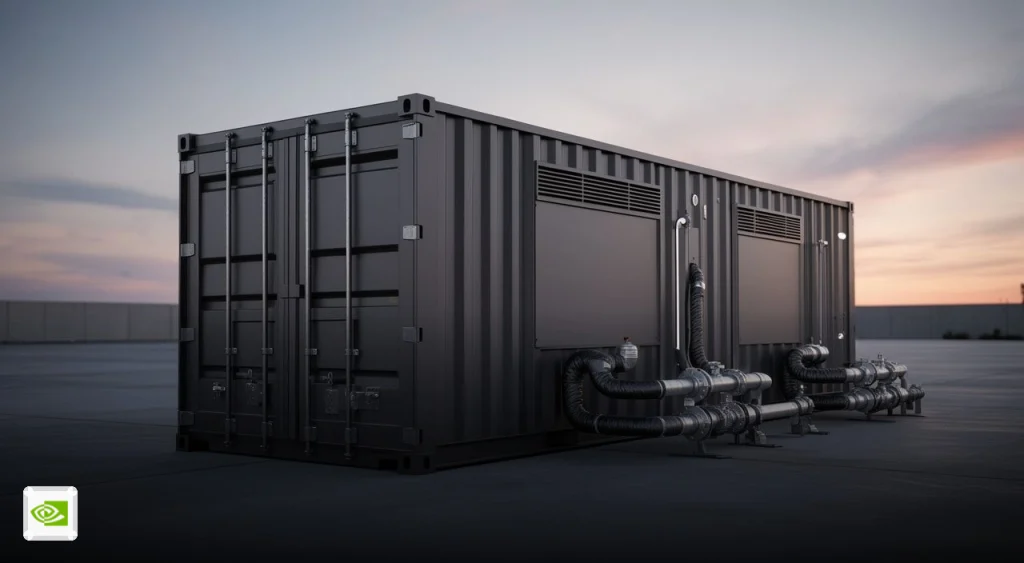
NVIDIA announced the DSX Pod AI Factory, which packs seven Vera Rubin AI racks into a standard shipping container. This unit weighs about 28,000 kilograms, and workers assemble all cabling and liquid cooling at the factory before shipping. Ian Buck, NVIDIA VP of hyperscale computing, stated, "When it arrives, it just needs to be placed, connected to other containers, and validated through final testing". Industry analysis notes that factory integration shortens the path to productive AI capacity. However, developers in places like Europe still need solid plans for local power and site connections before physical deployment can succeed.
What the DSX Platform Software Does for Grid Integration
Physical hardware only solves part of the infrastructure crisis, leaving over $300 billion in equipment currently backlogged. Furthermore, more than 200 gigawatts of projects wait in U.S. interconnection queues because the grid, facilities, and computing were historically designed in separate silos. The NVIDIA DSX platform unifies these systems to fix the problem. DSX Sim validates generators and switchgear before construction begins, while “DSX Flex syncs AI factory demand with grid conditions” to turn static loads into flexible grid assets. Partners are actively integrating these tools right now. Hitachi Energy qualified its battery storage as DSX Ready, and Schneider Electric is building Omniverse-powered digital twins. Finally, Siemens Energy is developing grid-aware power infrastructure reference designs.
How IREN Uses DSX Air to Simulate 50,000 GPUs
Before physical deployment, operators use the software to stress-test massive configurations. IREN and BE Networks are using “DSX Air to simulate and validate the network architecture” for more than 50,000 NVIDIA Blackwell Ultra GPUs. This logical simulation creates a realistic digital twin of the AI cloud environment. It allows engineers to validate NVIDIA AI compute, Spectrum-X Ethernet, and NVLink scale-up networking without risking physical hardware delays.
Why the DSX Zero-Water Liquid Cooling Design Eliminates Water Use
Beyond power and compute, cooling remains a critical physical constraint for modern data centers. Conventional cooling-tower systems consume roughly 2.6 million gallons of water per megawatt each year. To fix this, NVIDIA outlined a new closed-loop liquid cooling design. It pumps a 75-to-25 propylene glycol and water mixture into server racks at up to 45 degrees Celsius. This setup sheds heat via outdoor dry coolers without needing any mechanical chillers.
Ali Heydari is the director of data center cooling and infrastructure at NVIDIA. He explained in a company blog post that the new system saves resources. "The NVIDIA DSX reference design for AI factories has zero water consumption, eliminating massive power and almost all water usage," he noted.
What IT Decision-Makers Must Evaluate for Modular AI Infrastructure
Business owners and IT leaders selecting AI infrastructure must look beyond just GPU pricing and rack space. Physical resource constraints now dictate deployment timelines for these data centers. Industry market data shows that hyperscale AI data centers account for 46% of adoption in AI workload power smoothing and monitoring software. This reflects the urgent need to manage electrical limits. Decision-makers must now assess local grid interconnection queues, onsite generation capacity, and water availability alongside hardware costs. Integrating platforms like Phaidra uses DSX Flex to deliver “10% more compute within the same power envelope”. This proves that software-defined power management is now a mandatory part of enterprise AI strategy.
Related articles