Big Tech AI Spending 2026: What Microsoft, Alphabet, Amazon, and Meta Are Buying
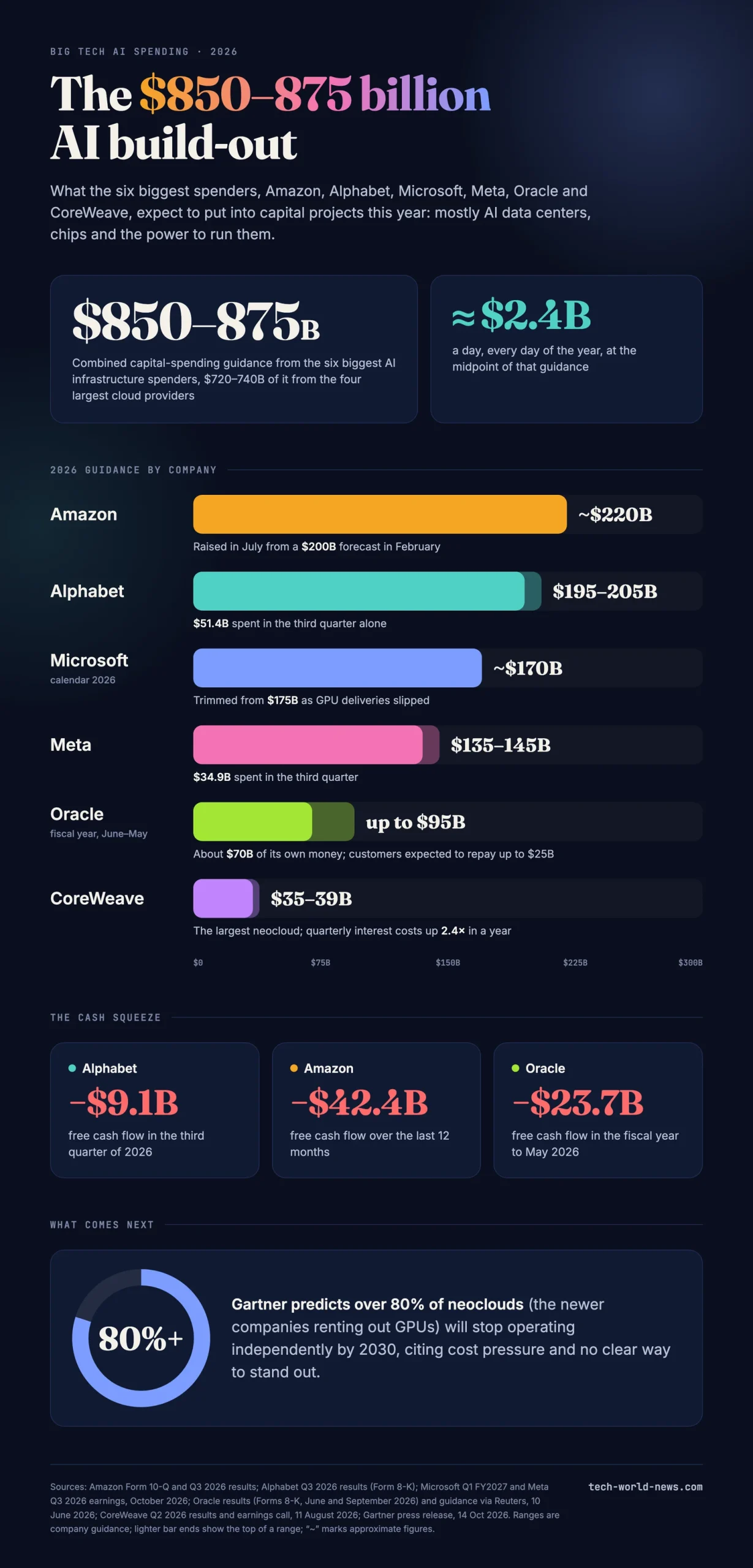
The four largest cloud providers (Amazon, Alphabet, Microsoft and Meta) are projected to spend between $720 billion and $740 billion on capital expenditures in 2026, primarily to build artificial intelligence data centers and secure computing power. Add Oracle and CoreWeave, which build AI computing capacity to rent to others, and the total rises to about $850 billion to $875 billion. This guide breaks down the exact financial figures, what this physical infrastructure buys, and how these massive investments directly impact the availability, pricing, and reliability of the AI tools your business relies on.
Because analyst estimates are updated quarterly as earnings are reported, early-year projections differ from late-year guidance. The table below consolidates the latest full-year 2026 capital expenditure guidance and the most recently reported quarterly actuals for the six biggest spenders.
| Company | 2026 Full-Year Guidance | Latest Reported Quarter Capex | Source & Date |
|---|---|---|---|
| Amazon | About $220 billion | $77.3 billion (Q3 2026) | Amazon Q3 results (8-K), Oct 29, 2026 |
| Alphabet | $195 billion – $205 billion | $51.4 billion (Q3 2026) | Alphabet Q3 results (8-K) and earnings call, Oct 28, 2026 |
| Microsoft | About $170 billion (calendar 2026) | $39.4 billion (Jul–Sep 2026) | Microsoft Q1 FY2027 earnings call and 10-Q, Oct 28, 2026 |
| Meta Platforms | $135 billion – $145 billion | $34.91 billion (Q3 2026) | Meta Q3 results (8-K), Oct 21, 2026 |
| Oracle | Up to $95 billion (fiscal year to May 2027) | $28.5 billion (Jun–Aug 2026) | Oracle 8-K, Sep 2026; Reuters, Jun 10, 2026 |
| CoreWeave | $35 billion – $39 billion | $9.4 billion (Q2 2026) | CoreWeave earnings call, Aug 11, 2026 |
Note: Combined full-year guidance across the four largest cloud providers totals approximately $720 billion to $740 billion; with Oracle and CoreWeave, the six companies total about $850 billion to $875 billion. Oracle’s figure covers its fiscal year ending May 2027 and includes up to $25 billion it expects customers to repay. Early 2026 estimates from analysts projected a lower combined total, reflecting the rapid upward revisions made throughout the year.
What $850–875 Billion Actually Buys
When tech giants announce massive capital budgets, the money does not go toward software development or marketing. It is deployed to purchase physical, real-world assets. The vast majority of this spending is directed at AI compute, data centers, and networking equipment.
Building an AI data center requires acquiring land, securing massive electrical grid connections, installing industrial cooling systems, and purchasing tens of thousands of graphics processing units (GPUs). Part of the scale also comes from higher hardware prices: when components cost more, the same amount of computing power takes more dollars to buy than it did a year earlier.
To put the scale into historical perspective, a late-2025 Morningstar analysis noted that Big Tech firms were planning to invest $5.2 trillion over five years, a pace that dwarfs previous technology build-outs.
How Infrastructure Delays Affect Your AI Tools
Tech World News
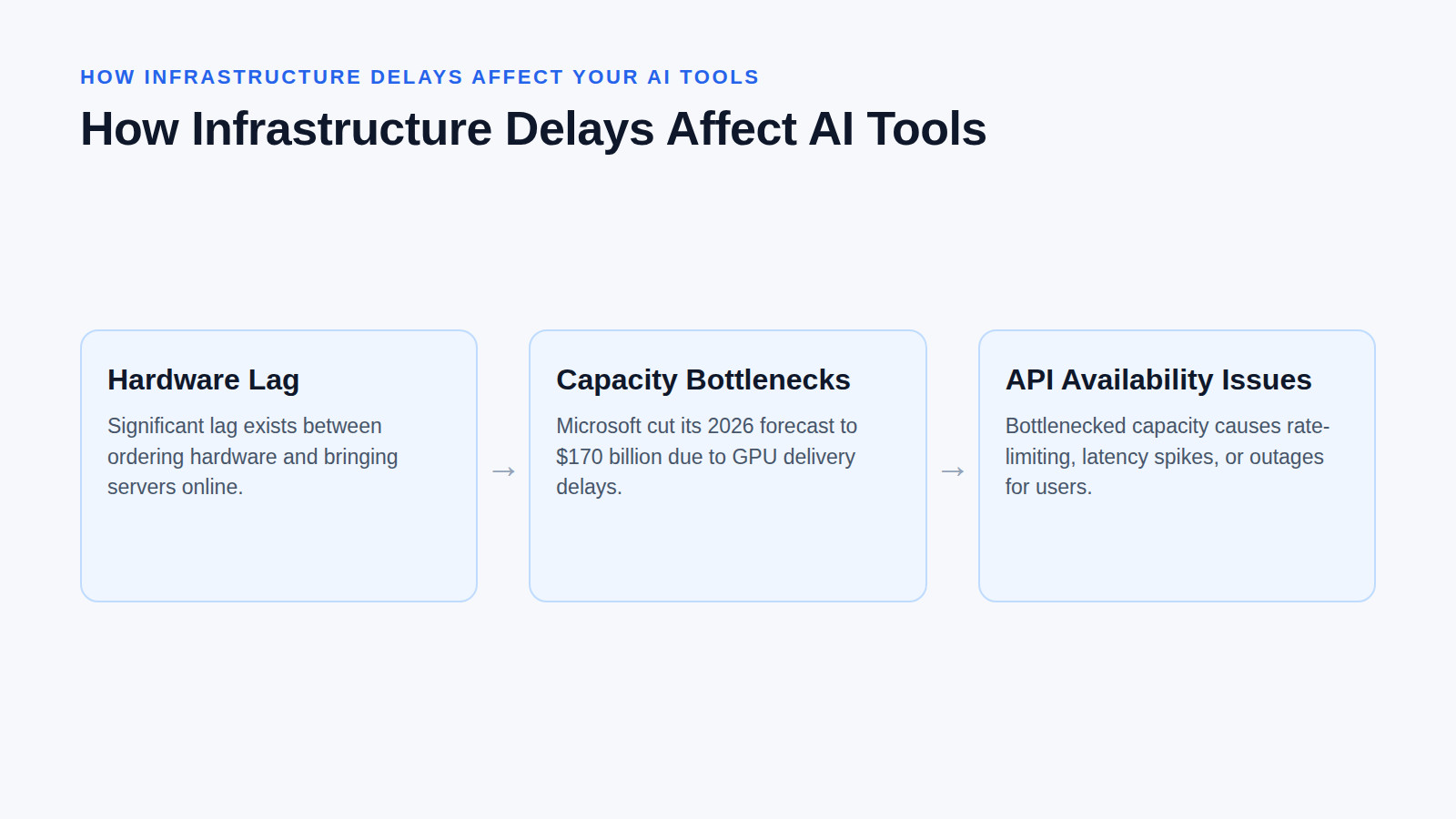
Spending billions of dollars does not instantly create usable computing capacity. There is a significant lag between ordering hardware, building the facility, and bringing the servers online. This lag is currently creating bottlenecks that directly affect businesses using AI APIs and cloud tools.
Microsoft reduced its 2026 forecast to $170 billion (down from an earlier $175 billion target) partly because third-party GPU providers experienced delivery delays. These delays will push some available computing capacity into the first half of 2027. Similarly, Alphabet’s finance chief noted that outside computing power it had arranged for the third quarter came online only at the very end of that quarter.
For business buyers, these physical delays translate into software availability issues. Pure-play AI vendors like OpenAI and Anthropic rely heavily on this hyperscaler and neocloud infrastructure to run their models. When underlying capacity is bottlenecked, enterprise API users can experience intermittent rate-limiting, latency spikes, or temporary outages during peak hours. If your business relies on continuous AI inference for customer-facing applications, you must plan for these infrastructure-induced availability gaps.
The Shift from Cash to Debt Financing
Tech World News
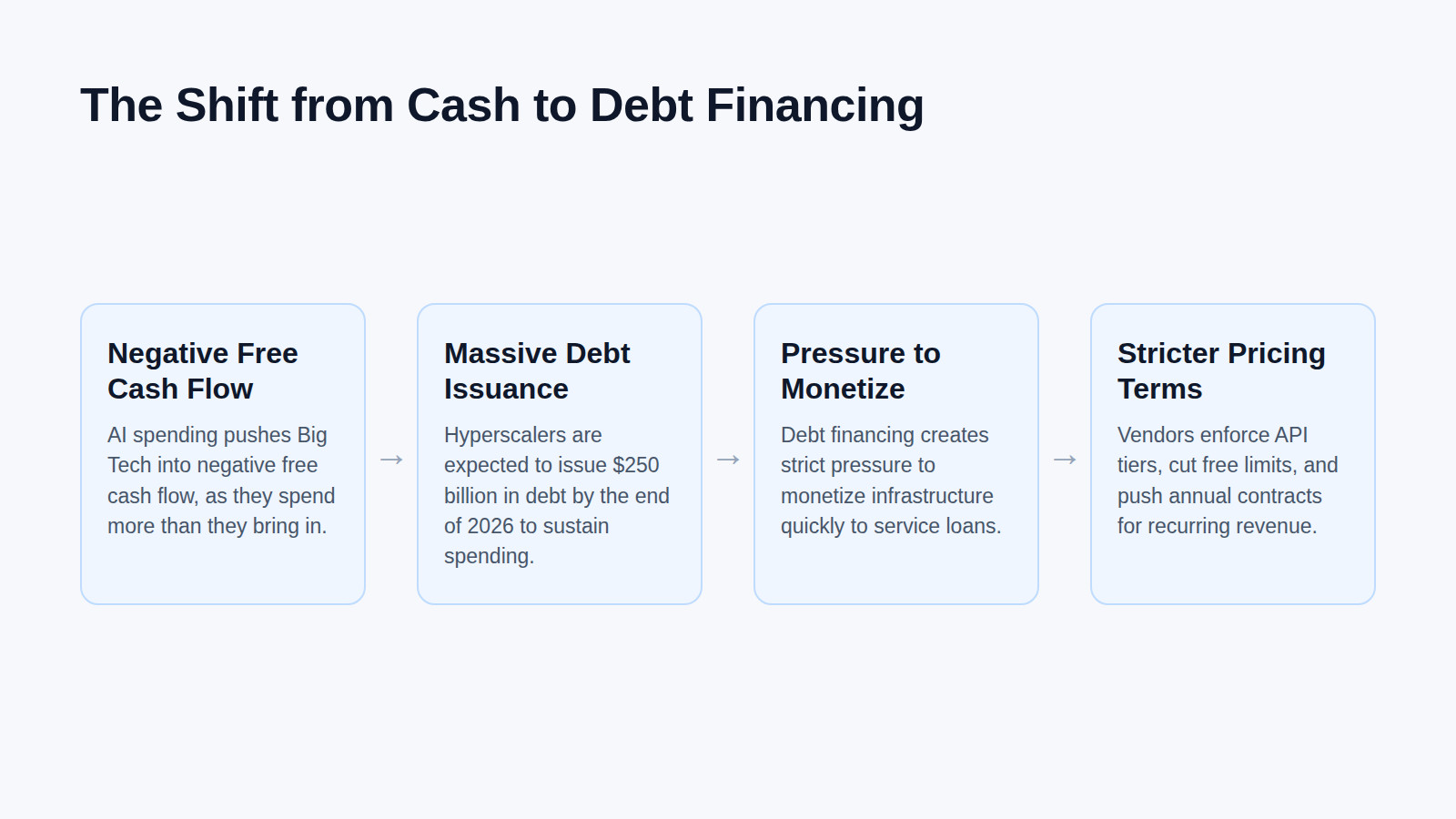
Historically, hyperscalers funded their massive growth using the overflowing free cash flow generated by their core businesses. For several of them, that era has paused. The intense spending requirements of AI infrastructure have pushed Alphabet, Amazon and Oracle into negative free cash flow in recent periods, meaning they spent more cash than they brought in.
Alphabet reported negative free cash flow of $9.1 billion in the third quarter of 2026. Amazon reported negative free cash flow of $42.4 billion over the past 12 months. To sustain this unprecedented spending, some forecasts expect hyperscalers to issue as much as $250 billion in debt by the end of 2026.
Oracle and CoreWeave show the same pattern even more sharply. Oracle reported negative free cash flow of $23.7 billion for its fiscal year ended May 2026, then another negative $5.4 billion in the June–August quarter, as quarterly capital spending jumped to $28.5 billion from $8.5 billion a year earlier. It plans to raise nearly $40 billion through debt and new shares in fiscal 2027. CoreWeave, the largest neocloud, reported $640 million in net interest expense in the second quarter of 2026, up from $267 million a year earlier, as it borrows to build capacity for customers under contract.
This shift from cash-funded growth to debt-funded growth has direct implications for software pricing. When companies finance infrastructure through debt, they face strict pressure to monetize that infrastructure quickly to service their loans. For business buyers, this financial reality often translates to stricter enforcement of API usage tiers, the reduction or elimination of free-tier limits, and a strong push from vendors toward annual enterprise contracts to guarantee recurring revenue.
What Business Buyers Should Watch in 2027
Tech World News
The macroeconomic trends in AI infrastructure spending create specific operational realities for IT decision-makers. Here is what you need to monitor as we move into 2027:
Neocloud Volatility and Vendor Risk
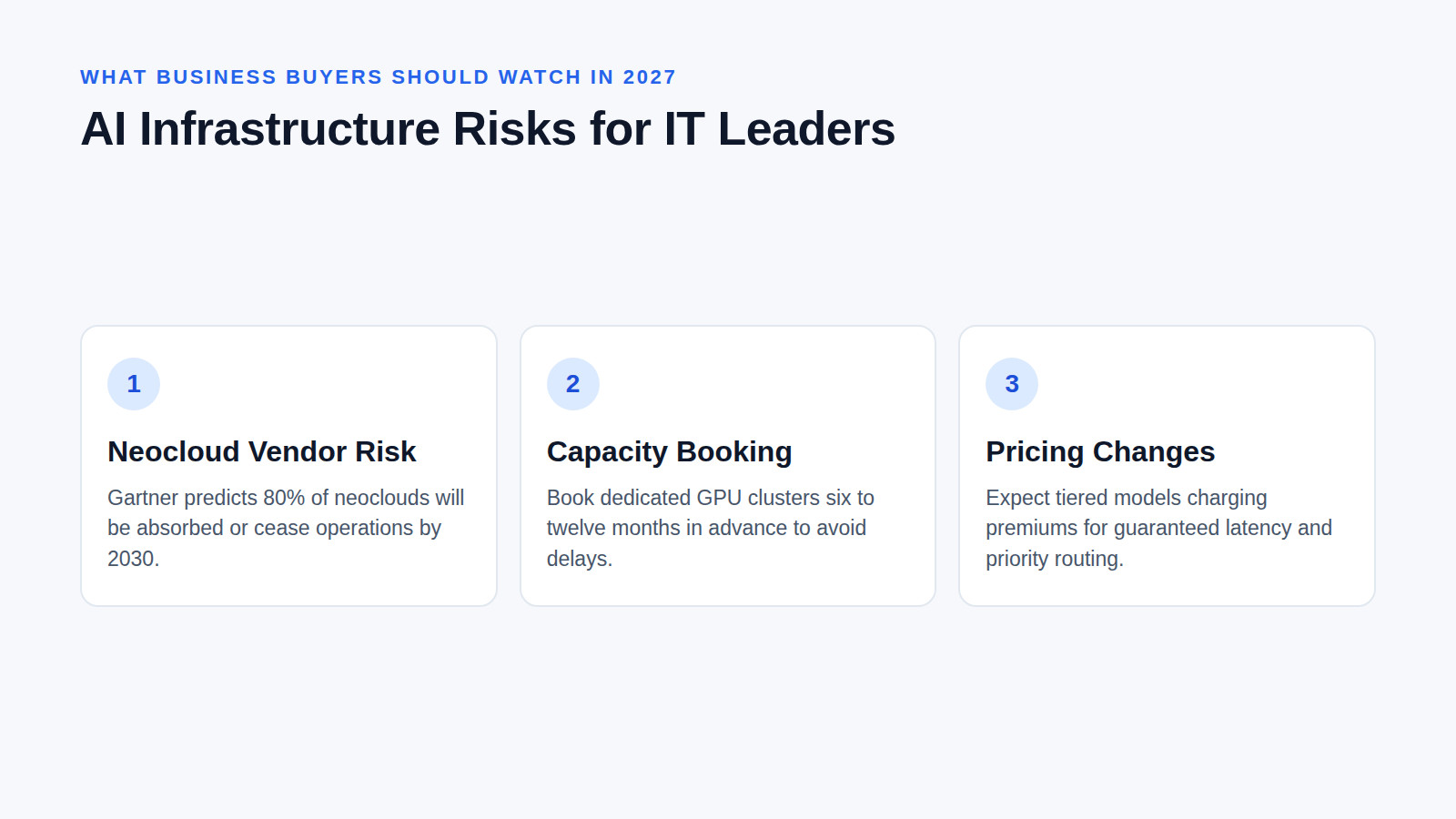
Hyperscalers are outsourcing some of their compute needs to "neoclouds" (specialized GPU cloud providers like CoreWeave, Lambda, and Nscale). However, these neoclouds require billions in outside capital and often lack investment-grade credit ratings. Gartner predicts that more than 80% of neocloud providers will stop operating independently by 2030, for example through acquisition or merger, citing cost pressure and a lack of a differentiated business model. If your business relies on a niche AI provider hosted on a neocloud, you must evaluate the financial backing and long-term viability of their underlying infrastructure partner.
Capacity Allocation and Booking
The market for AI compute is currently supply-constrained, not demand-constrained. If your organization requires dedicated GPU clusters for fine-tuning proprietary models or running heavy inference workloads, you may not be able to get this capacity on demand. IT leaders should plan and reserve cloud capacity well in advance to avoid deployment delays.
Pricing Restructuring
Expect a shift in how AI tools are priced. As providers seek to maximize revenue from their debt-heavy infrastructure, simple per-token pricing models will likely be supplemented by tiered models that charge significant premiums for guaranteed latency, dedicated compute, and priority routing.
Practical Takeaways for IT Decision-Makers
To navigate this environment, business leaders and IT managers should take the following steps:
- Audit your AI dependencies: Identify which of your critical business tools rely on third-party AI APIs. Determine if those providers host their models on major hyperscalers or smaller neoclouds, and assess the risk profile of those infrastructure partners.
- Negotiate capacity locks: If you are running high-volume AI workloads, move away from pay-as-you-go models. Negotiate annual contracts that include guaranteed compute capacity and defined latency SLAs to protect your operations from infrastructure bottlenecks.
- Diversify your model providers: Do not build your entire product architecture around a single AI vendor. Maintain integration flexibility so you can route workloads to alternative providers if your primary vendor experiences capacity outages or sudden price hikes.
- Budget for AI inflation: Adjust your IT budgets for the next fiscal year to account for the reality that AI compute costs are rising due to hardware inflation and the debt-servicing needs of cloud providers.
Frequently Asked Questions
How much did companies spend on AI in 2026?
The four largest hyperscalers are projected to spend between $720 billion and $740 billion in capital expenditures for 2026, and adding Oracle and CoreWeave brings the total to about $850 billion to $875 billion. Early in the year, analysts estimated the total would be lower, but rapid upward revisions pushed the combined total higher, with the vast majority of those funds directed toward AI data centers and computing infrastructure.
How much does Microsoft expect to spend on artificial intelligence in 2026?
Microsoft reduced its full-year 2026 capital expenditure guidance to $170 billion, down from an earlier forecast of $175 billion. The company cited delays from third-party graphics processing unit providers, which will push some available computing capacity into the first half of 2027.
How much are Oracle and CoreWeave spending on AI infrastructure?
Oracle expects capital expenditures of up to $95 billion in its fiscal year ending May 2027, about $70 billion of it its own money, with customers expected to repay up to $25 billion. CoreWeave expects to spend $35 billion to $39 billion in 2026, the range it gave with its second-quarter results in August 2026.
Will this infrastructure spending increase the cost of AI tools for businesses?
While massive spending eventually increases overall supply, the high cost of debt financing and component inflation means providers are under pressure to monetize their infrastructure quickly. Business buyers should expect reduced free-tier access, stricter enforcement of usage limits, and premium pricing tiers for guaranteed compute capacity and lower latency.
Related articles
- Global AI Investment by Country: Capital, Models, and Talent in 2026
- Amazon Accelerates Custom AI Chip Production to Meet AWS Demand
- How Does OpenAI Make Money? Revenue, Costs, and AI Pricing Explained
Reviewed by Shahid Anwer · Editorial standards