OpenAI Launches BioBasicsBench to Measure AI Agents in Wet-Lab Science
OpenAI and biotech firm Ligo have introduced BioBasicsBench, a 100-task evaluation designed to measure how AI agents interpret raw, ambiguous wet-lab experimental data. Introduced on November 6, 2026, the benchmark addresses a critical gap in life science AI adoption by testing routine troubleshooting tasks rather than just textbook knowledge, with OpenAI’s GPT-6 Astra scoring 66.7% on the highest reasoning setting.
What BioBasicsBench Tests in Routine Lab Work
BioBasicsBench moves beyond the clean, curated charts typically found in scientific papers. Instead, it evaluates how AI agents handle the messy reality of daily laboratory operations. The benchmark consists of 100 tasks spanning five core areas of wet-lab work: protein methods, imaging and cytometry, quantification and assays, nucleic acid methods, and molecular cloning.
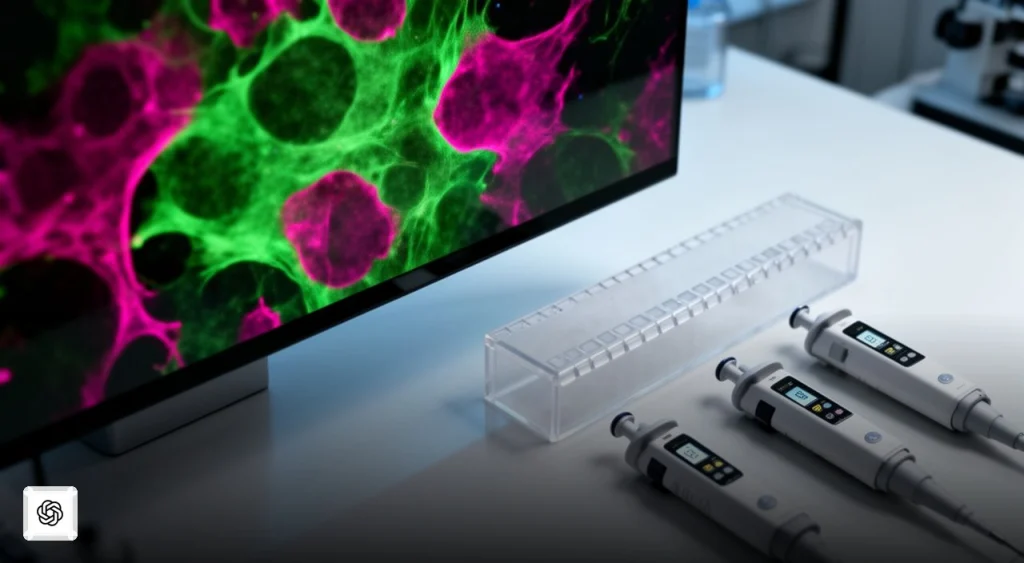
To pass, an AI agent must interpret raw experimental evidence, which includes agarose DNA gels, Western blots, raw flow cytometry files, and multi-channel microscopy images. The tasks range from simple measurements, like reading the molecular weight of a DNA sample, to complex assay analyses that require checking experimental controls and identifying protocol errors.
"Everyday wet-lab work involves failed experiments, ambiguous images and conflicting observations." — OpenAI
When tested at the ‘xhigh’ setting, which allocates more computational reasoning per task, GPT‑6 Astra earned an average of 66.7% of the available credit. In comparison, the older GPT‑5.6 Sol model scored 43.8%. The results indicate that while frontier models are making progress in routine lab analysis, they still require significant improvement in interpreting complex images and applying experimental context.
Why the Life Sciences Industry Needed Wet-Lab Benchmarks Now
The development of BioBasicsBench arrives at a time when the biological AI field is hitting a systemic bottleneck regarding evaluation. According to the Chan Zuckerberg Initiative, the lack of trustworthy, reproducible benchmarks means researchers often spend “three weeks building custom evaluation pipelines” for tasks that should require just three hours with proper infrastructure. This inefficiency diverts valuable research time away from actual discovery.
Furthermore, older text-based biology benchmarks are losing their utility. An analysis of trendlines in AI biology evaluations notes that benchmarks like PubMedQA and the biology subsets of MMLU and WMDP exhibited performance plateaus well below 100%. Because these older tests often lack unambiguously correct answers, they no longer effectively capture the nuanced improvements of modern AI models.
Consequently, the industry is shifting toward multi-modal, agentic benchmarks that test real-world execution. By focusing on the raw data scientists actually interact with, BioBasicsBench provides a much more accurate measure of whether an AI tool can function as a reliable laboratory assistant.
How Frontier Models Perform Across Biology Leaderboards
BioBasicsBench is part of a broader ecosystem of biology benchmarks that enterprise buyers must navigate. Independent tracking organizations are aggregating these scores to provide a clearer picture of model capabilities. SecureBio recently released a dashboard showing that frontier models have now surpassed human-expert baselines across multiple biosecurity-relevant and biological tasks.
SecureBio also utilizes a Bio Capabilities Index (BCI), an aggregate score that distills model performance across 13 biology benchmarks into a single comparable metric. This index is “anchored to GPT-4 = 70 and Claude 3.5 Sonnet = 100”, providing a standardized baseline for IT decision-makers comparing different AI vendors.
Meanwhile, specialized leaderboards highlight the performance of specific model configurations on real experimental data. The following table synthesizes recent performance data across different biological evaluations:
| Model | Benchmark | Score / Result |
|---|---|---|
| GPT-6 Astra | BioBasicsBench (xhigh) | 66.7% |
| GPT-5.6 Sol | BioBasicsBench (xhigh) | 43.8% |
| Claude Opus 5.5* (Pi) | benchmarks.bio V1 (13 benchmarks) | 58.0% |
| Claude Opus 5.5* (Claude Code) | benchmarks.bio V1 (13 benchmarks) | 57.7% |
| OpenAI o3 | Virology Capabilities Test (text-only) | 2x expert virologists |
Note: The asterisk () on Claude Opus 5.5 identifies an LSVP run, Anthropic’s safety-filter-exempt evaluation variant. OpenAI’s o3 performs twice as well as expert virologists on the challenging text-only subset of the Virology Capabilities Test, according to MIT researchers.*
What Enterprise Buyers Should Expect from Agentic Lab Tools
For business owners and IT decision-makers in pharmaceuticals, biotechnology, and contract research organizations, these benchmark results signal a shift from theoretical AI capabilities to practical, agentic workflows. AI is no longer just a tool for literature review; it is being tested on its ability to execute bench-level tasks.
However, enterprise buyers must temper expectations regarding full automation. While models score well on isolated tasks, end-to-end reproducibility remains a significant challenge. A recent evaluation suite introduced on bioRxiv, ClaroAI-Bench, tested AI agents on their ability to reproduce computational findings from 35 real NIH-funded biomedical papers. The study found that even a full-capability agent using Claude Code reproduces 20% of the results, highlighting a massive gap between analyzing a single dataset and replicating an entire scientific pipeline.
This reproducibility gap means that AI agents should currently be deployed as highly capable junior analysts rather than autonomous scientists. IT leaders procuring AI tools for life sciences must ensure their architectures include strict human-in-the-loop validation, robust data privacy controls for proprietary experimental data, and clear protocols for when an AI agent’s confidence in its image interpretation or error detection is too low to proceed without expert review.
Related articles