The future of medicine might not be brewing in a Silicon Valley lab, but 300 miles above Earth in low-Earth orbit. That’s where El Segundo-based Varda Space Industries is pushing the boundaries of biotechnology, using the unique environment of microgravity to manufacture pharmaceuticals that would be nearly impossible to produce on the ground.
By sending capsules filled with chemical compounds into orbit, Varda takes advantage of zero gravity to develop new drug formulations. Once the process is complete, those same capsules reenter the atmosphere carrying their delicate, high-value cargo back to Earth.
The approach isn’t just theoretical anymore. Varda became the first company to conduct a commercial manufacturing mission outside the International Space Station last year. Since then, it has successfully completed two more missions in early 2025, with another capsule launched on June 22. One more mission is scheduled for later this year, and 2026 is already fully booked with four launches.
Will Bruey, chief executive and co-founder of Varda Said,
“What’s special about next year is that the last two capsules will be going up on the same rocket. It will be the first time where we have two spacecraft in orbit at once, and we’ll start to move into a fleet mentality,”
A Bold Vision, Backed by Big Money
Bruey, a former SpaceX engineer, co-founded the company in 2021 with Delian Asparouhov, ex-principal at Khosla Ventures. Their vision just got a serious boost: in July, Varda announced a $187 million Series C round, led by Natural Capital and Shrug Capital, with participation from major names like Founders Fund, Peter Thiel, Khosla Ventures, and Lux Capital. This new funding brings the company’s total haul to $329 million.
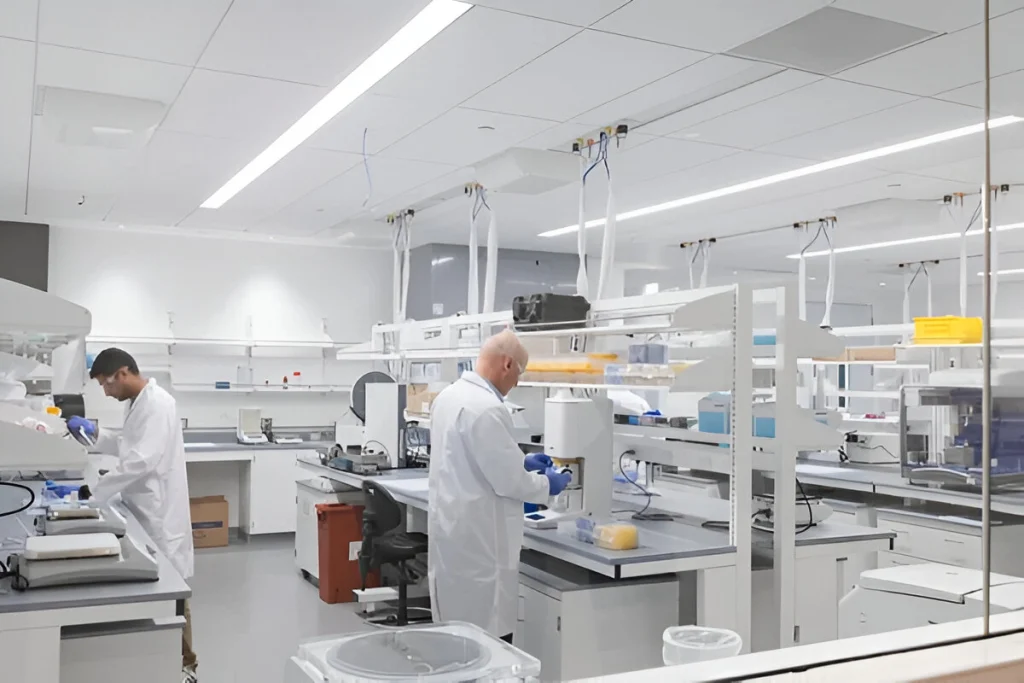
The capital will go toward scaling production of more capsules, more ground labs, and more advanced pharmaceutical experiments. Varda recently signed a 10,000-square-foot lease for a new dedicated lab near its El Segundo HQ, where teams will design and test molecules before they head into orbit.
If things go according to plan, capsule launches will eventually move from occasional events to near-routine operations. Bruey compares it to his days as a pizza delivery driver:
He said the goal isn’t to wait for one massive order but to deliver many pizzas hot and fast, in this case, capsules packed with life-changing biotech formulations.
How It Works
Each capsule, though compact (under two feet tall and one foot wide), functions as a specialized micro-lab. In space, conditions are dramatically different even something as simple as a gas bubble behaves unlike it does on Earth. That’s why Varda’s equipment is custom-built to ensure experiments succeed in orbit.
Molecules may take days to form, so capsules stay in space until the process is complete. When reentry begins, they slam back through the atmosphere at Mach 25, with mission control in El Segundo monitoring every second. It’s not just pharmaceuticals NASA and the Department of Defense have partnered with Varda to use the capsules as hypersonic wind tunnels for testing new materials.
Leading the Pack
For now, Varda is ahead of the competition. Startups like Atmos Space Cargo (Germany), Outpost Space, and Inversion Space (both California) are working on similar concepts, but none have managed a successful commercial mission yet. Even SpaceX has shown interest in biotech manufacturing in orbit, a move that validates the sector but also raises the stakes.
“More people are getting to see the huge opportunity. We’re actually pretty excited,” Bruey said. “We’ve collaborated with SpaceX the last five years. Our partnership right now is focused on the launch aspect, and we’ll continue to collaborate.”
Meanwhile, traditional space companies such as Axiom Space, Blue Origin, and Starlab are racing to build commercial space stations that could one day compete. But those projects are still years away. Varda has the advantage of being operational now, already testing, learning, and scaling.
Why It Matters
The biotech angle is what makes Varda’s work truly revolutionary. Inspired by a 2019 Merck experiment on the International Space Station, which proved that microgravity can improve crystallization, Varda’s technology could lead to better drug formulations and potentially brand-new medicines. Imagine an IV-only drug transformed into a stable pill, or biologics made more effective through space-grown crystal structures.
Asparouhov said,
“The partners that we have see us as a pharmaceutical company. They don’t see us as a space company. They bring us a drug that is having a particular problem, and we go solve it for them and hand it back,”
If successful, this fusion of space and biotech could reshape the pharmaceutical supply chain. Varda doesn’t invent drugs instead, it provides the environment and technology to manufacture them in ways previously impossible on Earth.With a $613 billion global space economy projected to hit $1 trillion by 2032, and an ever-expanding demand for advanced medicines, Varda sits right at the intersection of two trillion-dollar industries. Its vision is bold, but if it works, it could change how and where we make life-saving drugs.