
OpenAI Launches Grid Protectors Program to Manage Data Center Power Demand
On November 2, 2026, OpenAI launched the Grid Protectors Program, a national initiative requiring its future compute campuses to reduce electricity demand when local power grids are under strain. Starting with a planned facility in Effingham County, Georgia, the company has committed to providing up to 1,000 megawatts of flexible demand response—equivalent to the average usage of roughly 700,000 households—while paying full infrastructure costs to ensure local ratepayers do not subsidize AI expansion.
How the OpenAI Grid Protectors Program Operates in Georgia
The core mechanism of the initiative relies on demand flexibility rather than continuous maximum power draw. Modern compute facilities are fundamentally different from data centers built even a few years ago, allowing operators to modulate their power consumption dynamically. According to the company, future facilities will be designed to reduce electricity use when needed, working directly with utilities to establish “arrangements specifying how much demand can be reduced”, how quickly the reduction can occur, and the maximum duration of the curtailment.
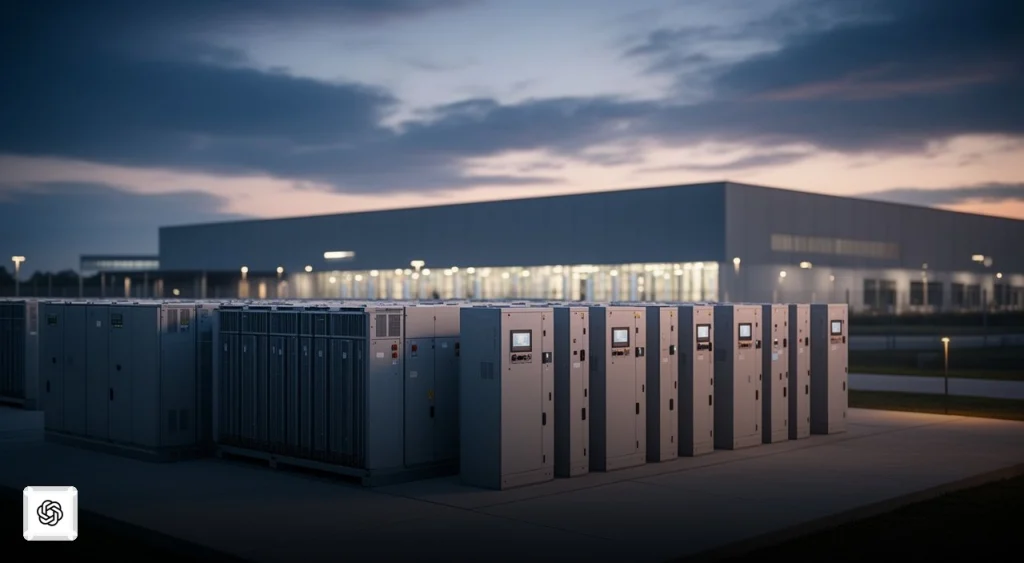
When the grid experiences peak strain—such as during a northern winter cold snap or a southern summer heat wave—OpenAI campuses will throttle their compute loads. To manage these transitions smoothly, the company plans to integrate on-site energy management systems. Depending on local requirements and available equipment, OpenAI will work with grid operators to “supply power from on-site generation or storage”, utilizing batteries and advanced power controls to balance the load.
"Our goal is to make campus flexibility a resource that utilities can call on when communities need it most." — OpenAI
This approach transforms the data center from a static energy consumer into a dynamic grid asset. By stepping back during peak hours, the campus preserves electricity for residential and commercial users, ensuring that critical community services remain operational without requiring the utility to activate expensive peaker plants.
Why OpenAI is Implementing Demand Response Now
The timing of this program aligns directly with the physical constraints of the U.S. power grid. Domestic data center capacity is projected to exceed 100 gigawatts by 2030, driven largely by the rapid growth in AI compute requirements. Building the transmission lines, substations, and generation facilities required to support this continuous peak demand is highly capital-intensive and slow to execute.
Grid infrastructure represents a fixed cost for utilities, whether the system is operating at partial or full capacity. If a massive compute campus draws maximum power continuously, the utility must build enough generation to meet that absolute peak, even if that peak only occurs for a few hours a year. Those infrastructure costs are typically spread across all ratepayers, effectively forcing local families and small businesses to fund the grid upgrades required by a single corporate tenant.
OpenAI is attempting to restructure this economic model. The company uses a specific analogy to explain the financial mechanics: "Imagine a restaurant in a vacation town. It needs enough tables and kitchen space for the busy season, but it has to pay for that capacity year-round." By acting as a steady, year-round customer that pays for baseline capacity but voluntarily reduces its load during the busy season of grid peak demand, OpenAI helps utilities maximize the efficiency of existing infrastructure. This limits the need for costly upgrades and prevents the broader public from absorbing the capital expenditures of AI expansion.
What the Georgia Power Agreement Means for Local Ratepayers
The practical application of these economics is visible in the specific terms negotiated for the Effingham County campus. OpenAI has committed to paying the full infrastructure and electric-service costs required to serve the project, ensuring that the utility can recover its capital investments directly from the compute operator rather than the general public.
The financial scale of this commitment is substantial. Through its broader portfolio and this specific agreement, Georgia Power projects approximately $950 million in annual customer savings beginning in 2029. These savings are generated by avoiding the construction of new, marginal generation capacity that would otherwise be required to serve the data center’s peak load.
Furthermore, the up to 1,000 megawatts of flexible demand response pledged by OpenAI directly translates to preserved residential power. At average electricity usage levels, shedding 1,000 megawatts frees up enough capacity to keep air conditioning running in approximately 700,000 households during extreme heat events. For context, that volume of households exceeds the combined populations of Washington, D.C., and Boston.
The company’s stated position is clear: "Families and small businesses should not be asked to subsidize a compute campus’s electricity needs." By fronting the infrastructure costs and providing flexible demand, OpenAI is structuring the Effingham project as a pilot to prove that large-scale AI facilities can coexist with local grids without driving up consumer utility bills.
How Grid Protectors Impacts Businesses Using AI Tools
For IT decision-makers and business owners procuring AI tools, the Grid Protectors Program introduces new variables into vendor risk assessment and operational planning. While the initiative is framed as a community benefit, it has direct implications for enterprise AI deployment.
First, service reliability during extreme weather events may fluctuate. If OpenAI is contractually obligated to shed 1,000 megawatts during a severe regional heat wave, the total compute capacity available for enterprise API requests will temporarily decrease. Businesses relying on continuous, real-time AI inference for critical operations should evaluate whether their vendors have disclosed how demand response events might impact latency or throughput. IT leaders may need to build local caching or fallback models to maintain operations during these planned curtailments.
Second, energy costs are a primary driver of AI inference pricing. By securing long-term grid stability and avoiding peak-demand infrastructure charges, OpenAI insulates its own operational margins from future energy price spikes. For business buyers, this suggests that API pricing could remain more stable over the long term, as the vendor is not forced to pass through the exorbitant costs of emergency peaker plant power or rapid grid expansion fees.
Finally, corporate procurement teams will need to update their ESG and vendor risk frameworks. Evaluating an AI provider’s grid resilience, energy sourcing, and demand response capabilities is becoming as critical as evaluating their data privacy policies. A vendor that frequently experiences unplanned outages because it lacks grid flexibility poses a continuity risk, whereas a vendor with a formalized demand response program demonstrates mature infrastructure management.
What IT Leaders Should Watch in Future OpenAI Campus Rollouts
While the Effingham County facility remains in development, it establishes the baseline template for all future OpenAI compute campuses. The company has indicated that the specific arrangements will differ by location, meaning IT leaders and industry analysts should monitor how these demand response contracts evolve across different regional grids.
Key metrics to watch include the speed of demand reduction and the integration of on-site battery storage. The value of a demand response program is dictated by how quickly a facility can throttle its load when the grid operator issues a curtailment signal. If OpenAI can demonstrate the ability to shed hundreds of megawatts within minutes using advanced power controls and battery discharge, it will set a new industry standard for data center grid integration.
Additionally, observers should track how often these demand response events are actually triggered. A program that is rarely invoked may serve primarily as a regulatory compliance measure, whereas a program that actively manages daily peak loads will fundamentally alter the economics of AI compute. The transition of the Effingham campus from a planned pilot to an operational reality will provide the first concrete data points on whether this flexible demand model can scale nationally to support the next generation of AI infrastructure.


