
Why Are AI Tools So Expensive? The Economics Behind Rising AI Subscriptions
AI tools are getting more expensive because the underlying compute costs for advanced reasoning models are rising, and heavily subsidized consumer pricing tiers are being replaced by usage-based enterprise models to achieve profitability. This guide breaks down the compute economics, the shift in software pricing models, and how businesses can control their AI spend.
| Metric | Figure | Source & Date |
|---|---|---|
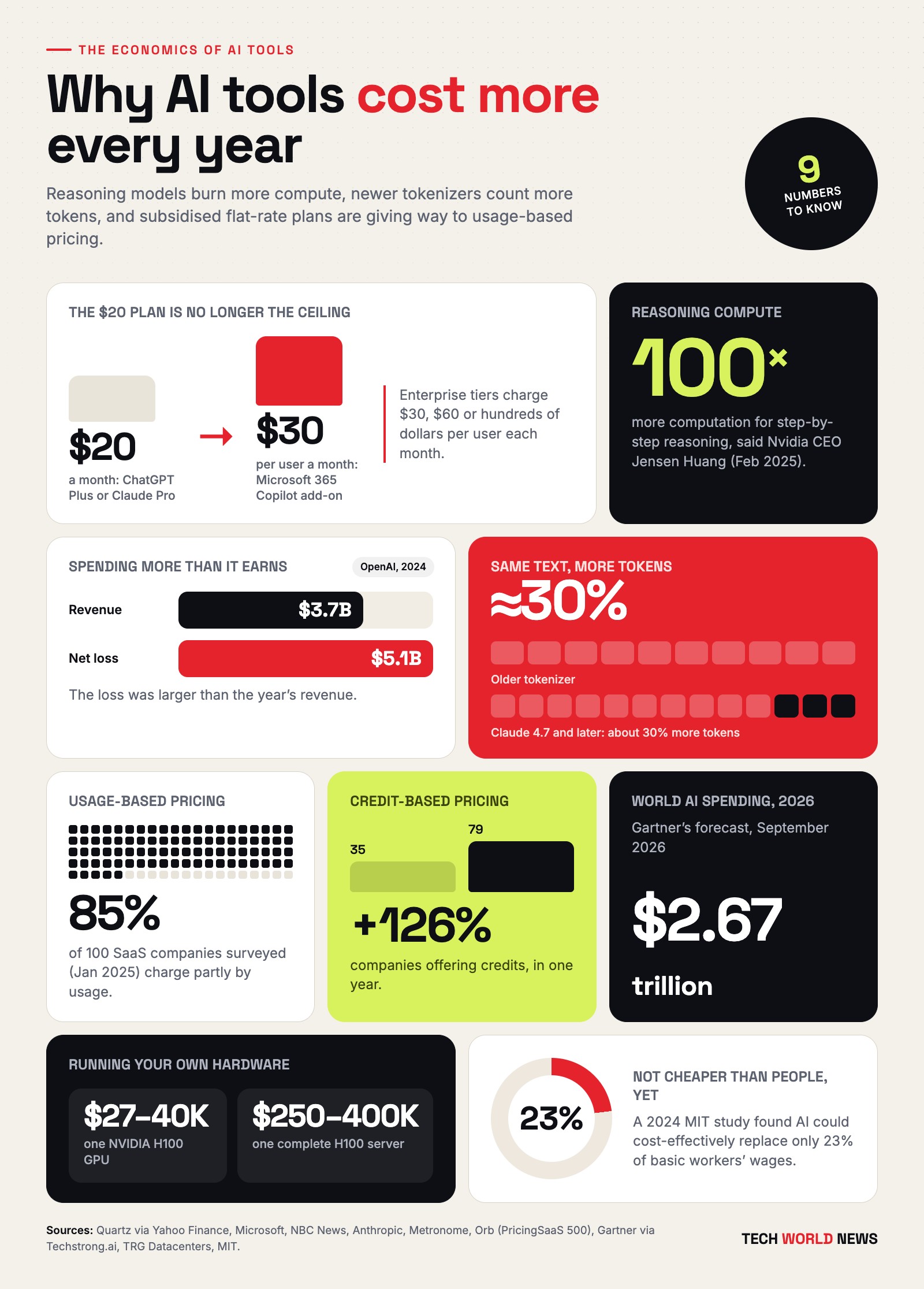
| OpenAI 2024 Net Loss | ~$5.1 billion | Quartz via Yahoo Finance |
| OpenAI 2024 Revenue | ~$3.7 billion | Quartz via Yahoo Finance |
| Microsoft 365 Copilot Add-on Price | $30 per user/month | Microsoft Learn (n.d.) |
| Claude Opus 5 Input Token Price | $5 per million tokens | Anthropic Docs (n.d.) |
| Gartner 2026 Worldwide AI Spending Forecast | $2.67 trillion | Gartner via Techstrong.ai (Sep 2026) |
| SaaS Companies Using Usage-Based Pricing (survey of 100, Jan 2025) | 85% | Metronome (2025) |
Tech World News
Why the $20 Consumer Subscription Is Disappearing
The standard $20 monthly consumer subscription for AI assistants is an unsustainable market-building exercise funded by venture capital rather than a reflection of actual operating costs. As AI providers face pressure to show profits, businesses are encountering enterprise tiers that routinely charge $30, $60, or hundreds of dollars per user per month for advanced access.
For years, consumers and small teams paid roughly $20 a month for tools like ChatGPT Plus or Claude Pro. According to MindStudio, this pricing was designed to build market share while investors covered the massive gap between what users pay and what providers spend to serve them. According to financial documents verified by the Financial Times, OpenAI posted a net loss of about $5.1 billion in 2024 on $3.7 billion in revenue. When investor patience thins and companies push for profitability or prepare for public offerings, the consumer subsidies end.
For business buyers, this means the era of flat-rate, unlimited AI access is closing. Microsoft currently charges a $30 per user per month add-on for full Copilot integration in Word, Excel, and Teams, requiring an existing qualifying Microsoft 365 license. Small and mid-sized businesses can find bundled plans for roughly $21 to $22 per user per month, but the fundamental shift toward premium, tiered access is already locked into enterprise software budgets.
How Advanced Reasoning Models Drive Up Compute Costs
Tech World News
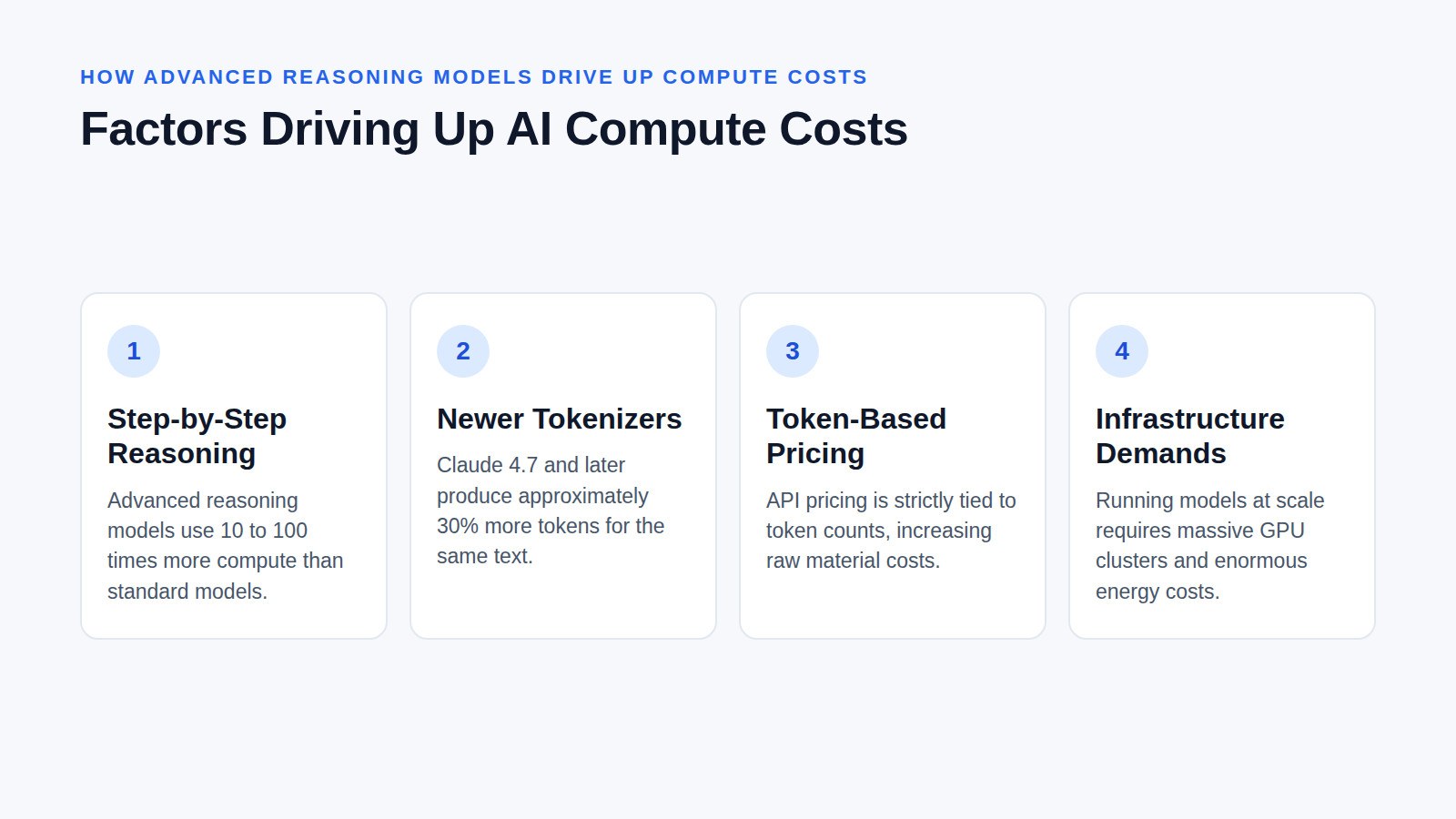
Inference costs for large language models are rising rather than falling because newer, more capable reasoning models require exponentially more compute power to process complex tasks step-by-step. Additionally, changes in how text is tokenized mean that the same amount of human text now consumes more billable units.
Historically, technology followed a pattern where computing power and storage became exponentially cheaper over time. AI breaks this historical trend. Running a large language model at scale requires massive GPU clusters and enormous energy costs. Advanced reasoning models, which think through problems step-by-step before answering, push this further: Nvidia CEO Jensen Huang said in February 2025 that the computation needed for that reasoning process is “100 times more than what we used to do”.
Furthermore, the underlying mechanics of how models read text have changed. Anthropic notes that Claude 4.7 and later models use a newer tokenizer that produces “approximately 30% more tokens for the same text”. Because API pricing is strictly tied to token counts, this architectural improvement in model comprehension directly increases the raw material cost for developers and businesses routing text through the API.
What the Shift to Usage-Based Pricing Means for Your Budget
Usage-based pricing has become the default model for AI software because flat seat-based licenses break down when individual user consumption varies by up to 20 times within the same plan tier. Businesses must now budget for variable compute consumption rather than predictable per-user software licenses.
A January 2025 survey of 100 SaaS companies by Metronome and Greyhound Capital found 85% had adopted some form of usage-based pricing, and Orb, citing PricingSaaS 500 data, reports the number of companies offering credit-based pricing grew about 126% in a year, from 35 to 79. Lago reports that “92% of AI companies that charge for usage have already changed their pricing” as they scale, indicating that the market is still searching for a sustainable equilibrium. Mature companies are increasingly landing on hybrid models that combine a base subscription floor with metered usage to balance revenue predictability with fair cost allocation.
For IT decision-makers, this requires a fundamental change in procurement. You are no longer just buying a software seat; you are buying a volume of compute. OpenAI now structures ChatGPT Enterprise around credit-based or token-based rate cards rather than simple flat fees, meaning your monthly bill will fluctuate based on how heavily your team utilizes advanced features like deep research or high-effort reasoning.
How Much Does It Cost to Build and Run Enterprise AI?
Tech World News
Building and operating custom enterprise AI requires massive capital expenditure for specialized talent, cloud compute, and physical hardware, pushing total costs far beyond simple API subscriptions. Organizations must budget for millions in development labor and hundreds of thousands in ongoing infrastructure to maintain proprietary models.
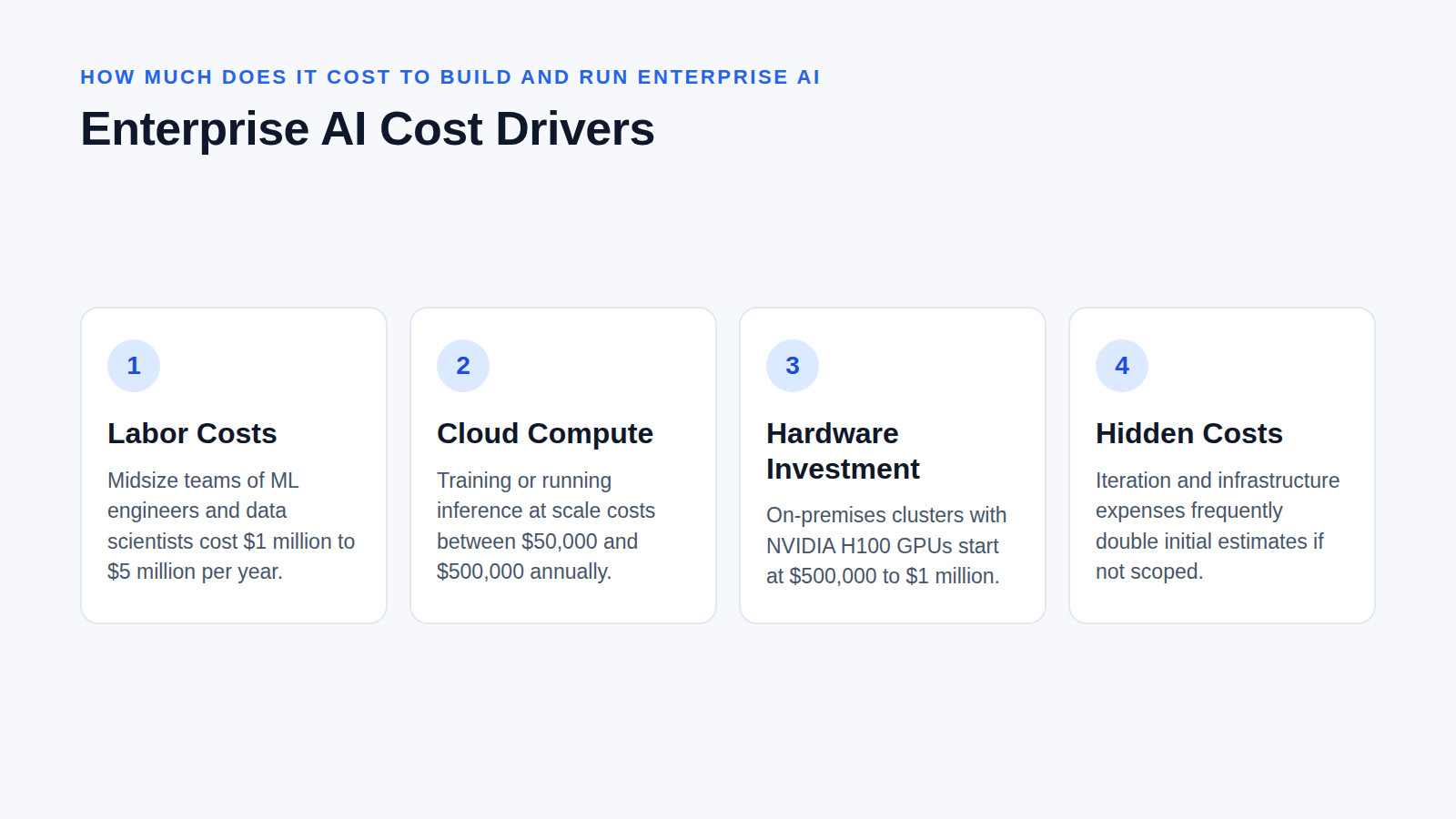
The financial reality of enterprise AI extends well beyond SaaS subscriptions. Hiring the necessary machine learning engineers and data scientists results in “labor costs ranging from $1 million to $5 million per year” for a midsize team. Cloud compute for training mid-sized models or running inference at scale can run between $50,000 and $500,000 annually.
For organizations requiring strict data residency or cost control through on-premises deployments, the initial hardware investment is substantial. A single NVIDIA H100 GPU costs roughly $27,000 to $40,000 and a complete H100 server around $250,000 to $400,000, so a modest cluster with high-speed storage and cooling quickly runs to several hundred thousand dollars, excluding ongoing maintenance and specialized staffing. These hidden iteration and infrastructure costs frequently double initial estimates if not carefully scoped.
Is AI Actually Cheaper Than Human Labor?
Tech World News
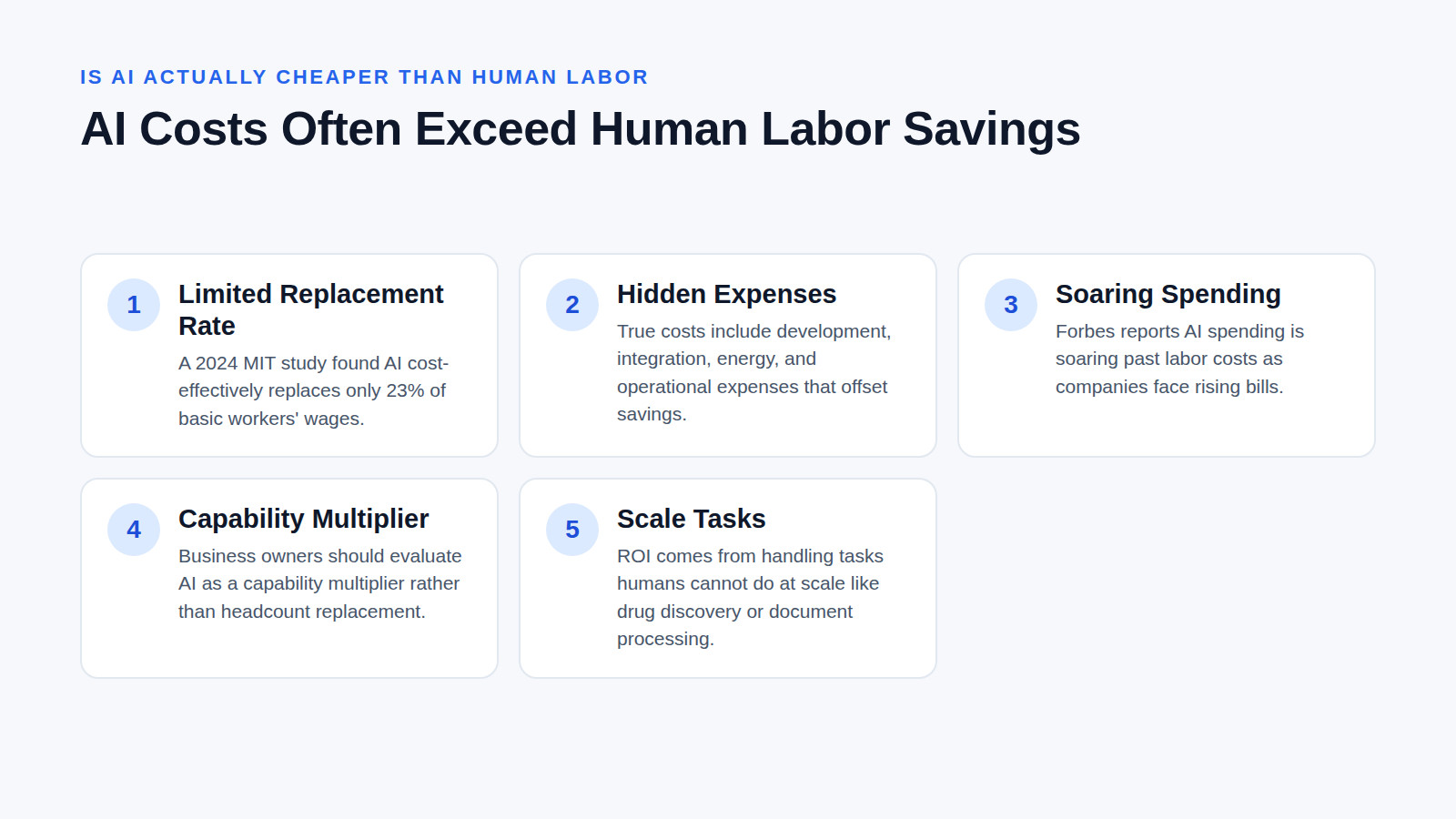
Despite early promises of massive cost reduction, current AI economics often make it more expensive than human labor for many standard business tasks, limiting its cost-effective replacement rate to a fraction of basic wages. The true cost of AI adoption includes development, integration, energy, and hidden operational expenses that offset labor savings.
A 2024 MIT study found that AI could only cost-effectively replace 23% of basic workers’ wages, challenging the narrative that automation automatically equals payroll reduction. Forbes reports that AI spending is soaring past labor costs as companies face rising bills that challenge the promised productivity gains.
"AI spending is soaring past labor costs as companies cut jobs, burn budgets and face rising bills that challenge promised productivity." — Forbes
For business owners, this means AI should be evaluated as a capability multiplier rather than a direct headcount replacement. The ROI comes from handling tasks that humans cannot do at scale, such as processing millions of documents for predictive maintenance or accelerating drug discovery, rather than simply replacing a customer support agent.
Practical Ways to Control Your Business AI Spend
Controlling AI spend requires implementing strict routing logic, optimizing prompt lengths, and utilizing smaller models for routine tasks to prevent expensive compute waste on simple queries. Businesses must treat AI compute as a variable utility cost and establish governance policies before deployment.
- Implement Model Routing: Do not use your most expensive, capable model for every task. Route simple classification or extraction tasks to cheaper, faster models, reserving premium models for complex reasoning.
- Optimize Context Windows: Because tokenizers now generate more tokens for the same text, keep system prompts and context injections concise. Passing massive, unstructured documents into the context window will rapidly drain credit-based budgets.
- Set Hard Usage Limits: Utilize workspace settings and role-based access controls to cap usage. In enterprise platforms, admins can control model access and set limits to prevent runaway inference costs.
- Monitor Tokenizer Changes: Stay aware of underlying architecture updates. A shift to a newer tokenizer can silently increase your token consumption for the exact same text payload, requiring immediate prompt optimization.
Frequently asked questions
What is a $900,000 AI job?
A high-cost AI role refers to the total compensation and infrastructure required to build and maintain enterprise-scale AI systems, not a single salary. Building moderately complex natural language processing systems requires machine learning engineers, data scientists, and domain experts, resulting in labor costs ranging from $1 million to $5 million per year for a midsize team.
What is the 30% rule in AI?
The 30% rule refers to the recent change in how AI models tokenize text, where newer architectures produce approximately 30% more tokens for the exact same human-readable text. This means businesses paying per million tokens will see their raw material costs increase by roughly 30% for identical workloads when upgrading to newer model versions.
Is AI getting cheaper or more expensive?
While basic storage and traditional computing have followed a decades-long trend of becoming exponentially cheaper, AI inference costs are currently rising due to the massive compute required for advanced reasoning models. The shift toward more capable, step-by-step reasoning models uses significantly more GPU power, driving up the per-query cost for businesses.
How to avoid AI pricing shocks?
Businesses can avoid pricing shocks by shifting from flat-rate assumptions to usage-based budgeting and implementing intelligent model routing. By directing simple tasks to smaller, cheaper models and setting strict administrative limits on context window sizes, organizations can prevent expensive compute resources from being wasted on basic queries.
Reviewed by Shahid Anwer · Editorial standards