
How to Write an AI Use Policy for Your Company (with Template)
An AI use policy template provides a structured framework to define approved tools, classify restricted data, and establish accountability for AI-generated output. This guide breaks down the essential components of an acceptable use policy, offering a practical template for small and mid-sized businesses to manage shadow AI and mitigate security risks.
Why Your Business Needs an AI Acceptable Use Policy
An AI acceptable use policy establishes clear boundaries for employee technology adoption, preventing unauthorized data exposure and ensuring compliance with emerging regulations. Without formal governance, organizations face significant risks from unmanaged AI usage, including intellectual property leakage and biased outputs.
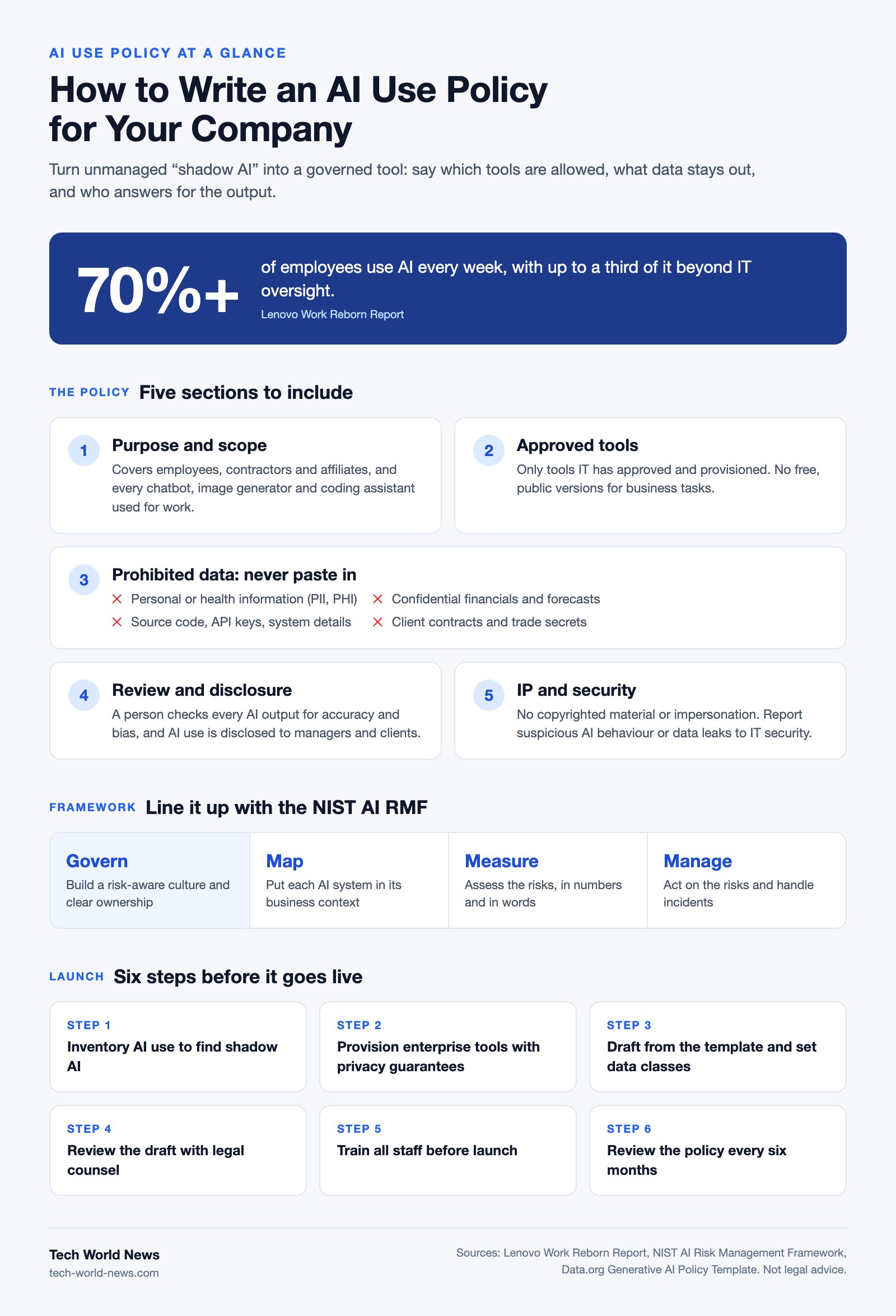
Lenovo’s Work Reborn Report found that “more than 70% of employees are using AI weekly”, with up to one third operating beyond IT oversight. This unmanaged usage creates "shadow AI," expanding the attack surface across devices and data flows.
"AI adoption is no longer the challenge. Execution is." — Rakshit Ghura, Vice President and General Manager, Digital Workplace Solutions, Lenovo
Fisher & Phillips highlights that public generative AI tools carry serious “security, accuracy, and intellectual property risks” when used without corporate knowledge. A formal policy transitions AI from an unmanaged personal productivity tool into a governed enterprise asset.
What to Include in Your AI Use Policy Template
Tech World News
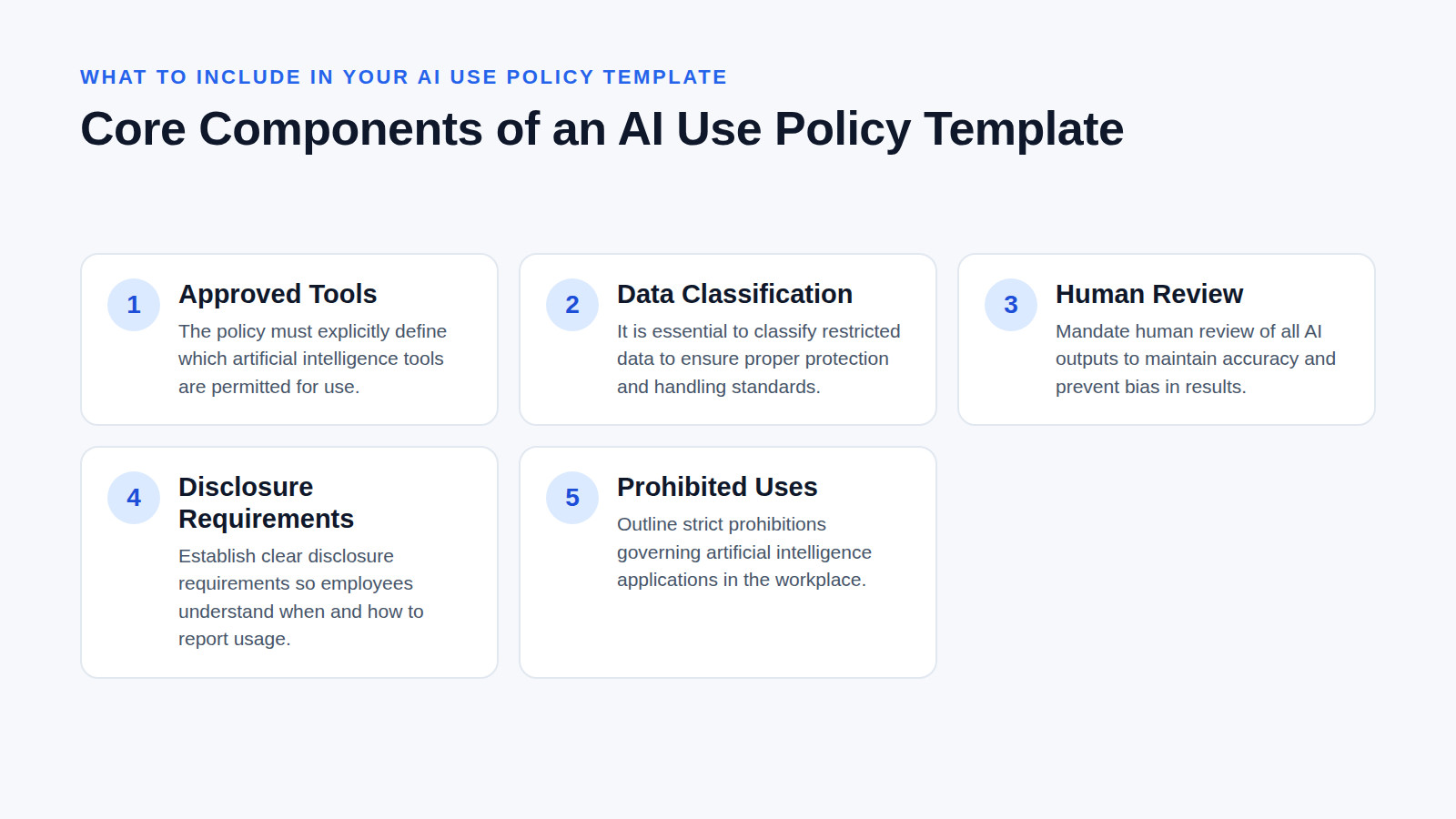
A comprehensive AI use policy template must define approved tools, classify restricted data, mandate human review of AI outputs, and establish clear disclosure requirements. These core components ensure employees understand both the permitted applications and the strict prohibitions governing artificial intelligence in the workplace.
According to centrexIT, a robust policy covers purpose and scope, data classification, approved tools, general guidelines, prohibited uses, and accountability. TechSoup emphasizes that policies must help organizations “follow existing legal and regulatory standards”, protect data, and prevent bias. A well-structured document bridges the gap between high-level corporate ethics and daily operational tasks, ensuring staff know exactly what is expected when interacting with machine learning models.
How to Classify Data for AI Tools
Data classification for AI tools requires explicitly defining which information categories employees may input into public models and which must remain strictly confidential. Clear boundaries prevent the accidental exposure of proprietary code, customer records, and internal strategies to third-party AI training datasets.
Data.org’s template stresses that Gen AI tools used will only utilize data that respects users’ rights and privacy. Prohibited data typically includes Personally Identifiable Information (PII), Protected Health Information (PHI), login credentials, and unpublished trade secrets. IBM warns that AI systems can inadvertently learn and exhibit biases that might be present in the training data, making the input data’s integrity and privacy critical. If an employee inputs a flawed or biased internal dataset into a public model, the resulting output will reflect and amplify those flaws.
Establishing Accountability and Review Protocols
Tech World News
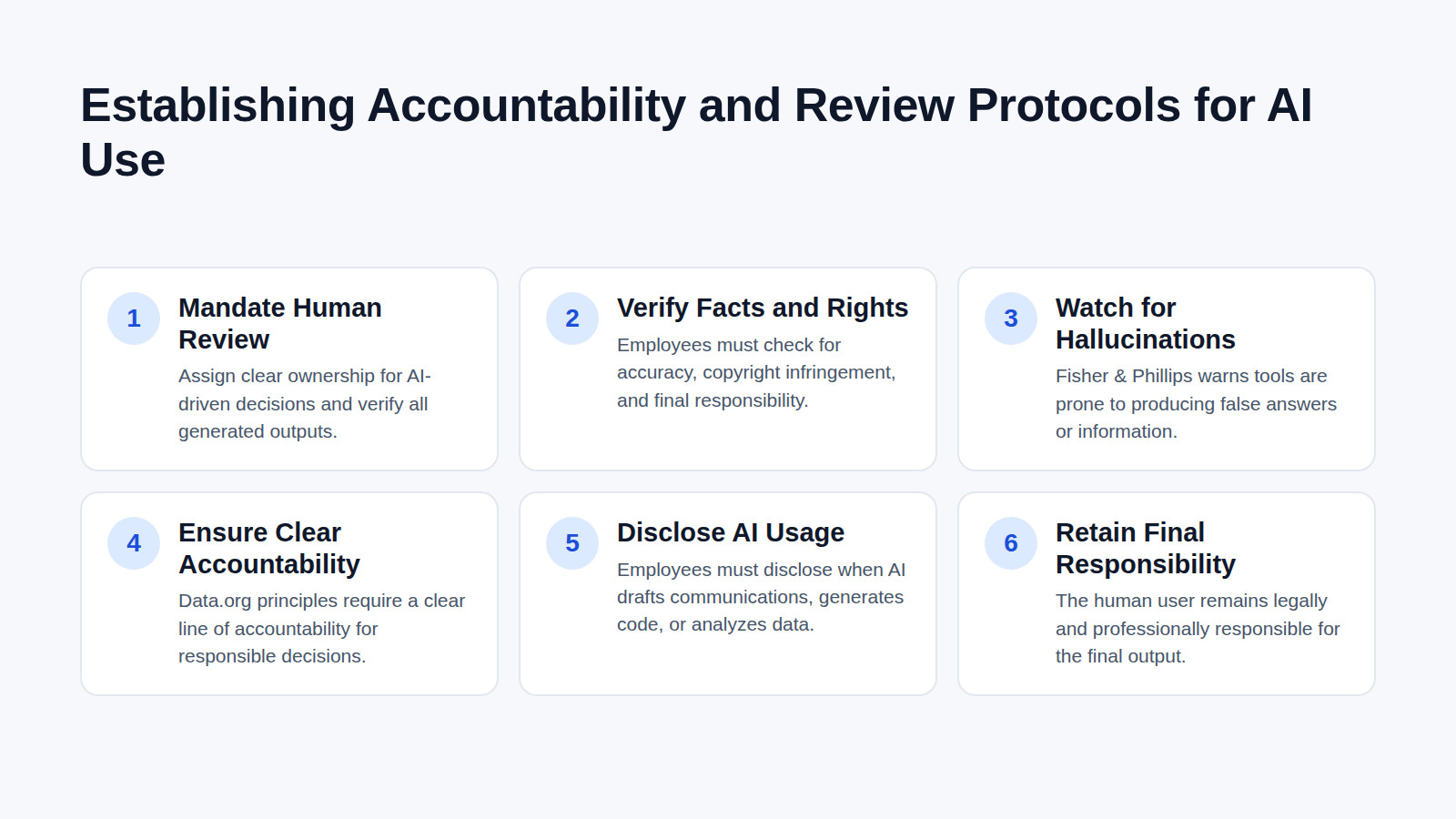
Establishing accountability for AI use requires mandating human review for all generated outputs and assigning clear ownership for AI-driven decisions. Because generative models frequently produce inaccurate information, employees must verify facts, check for copyright infringement, and take final responsibility for the work product.
Fisher & Phillips warns that many tools are prone to "hallucinations," false answers or information. Data.org’s template sets the principle that for every Gen AI solution, there should be a "clear line of accountability to ensure responsible decision-making." Employees must disclose when AI is used to draft client communications, generate code, or analyze financial data. The human user remains legally and professionally responsible for the final output, regardless of how it was generated.
Aligning Your Policy with the NIST AI Risk Management Framework
Aligning your internal policy with the NIST AI Risk Management Framework provides a structured, voluntary approach to managing artificial intelligence risks across the system lifecycle. Its Core organizes AI risk management into four functions: Govern, Map, Measure, and Manage, ensuring technical and ethical challenges are systematically addressed.
The NIST AI RMF emphasizes accountability, transparency, and ethical behavior in deployment. The ‘Govern’ function builds a risk-aware culture, ‘Map’ contextualizes systems within their operational environment, ‘Measure’ assesses risk quantitatively and qualitatively, and ‘Manage’ implements risk responses. Orca Security notes that adoption starts with governance and inventory, then maps risks, measures controls, and manages incidents. Futurium adds that organizational policies serve as a middle ground between non-binding ethical principles and current regulations, translating abstract concepts into actionable tasks.
What Software Development Teams Must Watch For in AI Policies
Tech World News
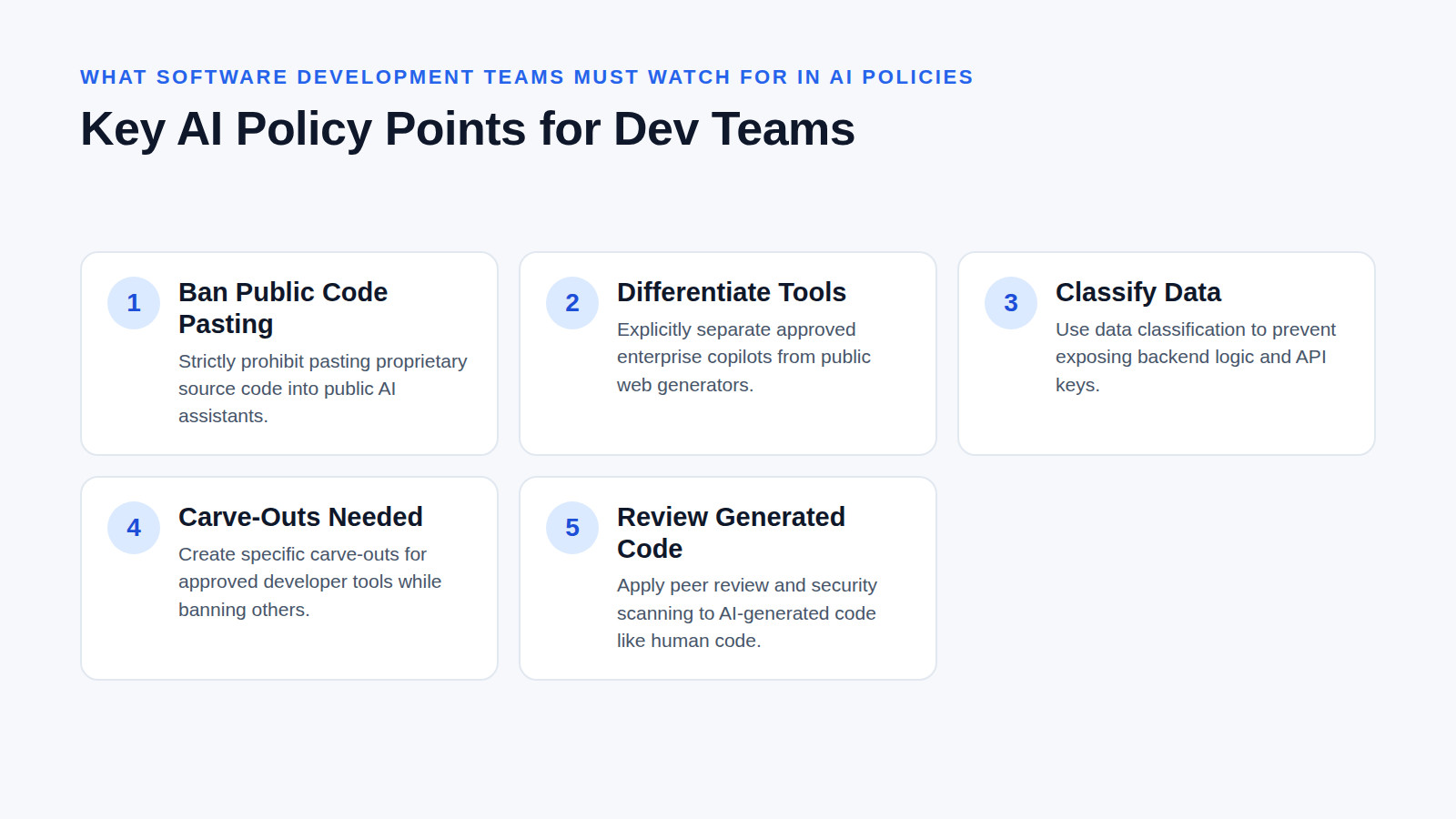
Software development teams must watch for strict prohibitions on pasting proprietary source code into public AI assistants, as this can compromise intellectual property and introduce security vulnerabilities. Policies must explicitly differentiate between approved, enterprise-grade coding copilots and public web-based generators.
When developers use unauthorized tools, they risk exposing backend logic, database schemas, and API keys. centrexIT highlights the need for data classification for AI use to prevent this exact scenario. Development teams need specific carve-outs for approved developer tools while strictly banning public alternatives for code generation. Furthermore, AI-generated code must be subjected to the same rigorous peer review and automated security scanning as human-written code to prevent the introduction of undocumented vulnerabilities.
Copy-Ready AI Use Policy Template for Small and Mid-Sized Businesses
Tech World News
This copy-ready AI use policy template provides small and mid-sized businesses with a foundational document to safely govern employee access to generative artificial intelligence tools. It clearly outlines approved software, strict data prohibitions, mandatory human review processes, and essential security protocols in plain English.
Disclaimer: This template is for informational purposes only and does not constitute legal advice. Consult with legal counsel before implementation.
1. Purpose and Scope
This policy applies to all employees, contractors, and affiliates using third-party generative AI tools. It covers chatbots, image generators, and coding assistants used for business purposes.
2. Approved Tools
Employees may only use AI tools explicitly provisioned and approved by the IT department (e.g., Microsoft Copilot for M365). The use of free, public-tier web interfaces for business tasks is strictly prohibited.
3. Prohibited Data
Never input the following into any AI tool:
- Personally Identifiable Information (PII) or Protected Health Information (PHI).
- Confidential financial data, forecasts, or unreleased earnings.
- Proprietary source code, API keys, or system architecture details.
- Client contracts or unpublished trade secrets.
4. Output Review and Disclosure
All AI-generated content must be reviewed by a human for accuracy, bias, and appropriateness before use. Employees must disclose to managers and clients when AI tools are used to create deliverables.
5. Intellectual Property and Security
Do not use AI to generate copyrighted material or impersonate individuals. Report any suspicious AI behavior or potential data leaks to the IT security team immediately.
Pre-Launch Checklist for IT Leaders
- Inventory current AI usage across all departments to identify shadow AI.
- Select and provision enterprise-grade AI tools with data privacy guarantees.
- Draft the policy using the template above and customize data classifications.
- Review the draft with legal counsel to ensure compliance with local regulations.
- Conduct mandatory training sessions for all staff before the policy goes live.
- Set a calendar reminder to review and update the policy every six months.
Frequently asked questions
What is an AI use policy template?
An AI use policy template is a foundational document that outlines the rules, principles, and restrictions for using artificial intelligence technologies within an organization. It provides a starting point for businesses to customize their own acceptable use guidelines, ensuring ethical, lawful, and secure AI adoption.
Who owns the AI use policy in a company?
Ownership of an AI use policy typically falls to a cross-functional group involving IT, legal, human resources, and executive leadership. While the IT department often drafts the technical controls, HR manages employee compliance, and legal ensures regulatory alignment, making it a shared corporate governance asset.
Should AI use be included in the employee handbook?
Yes, AI use guidelines should be integrated into or referenced directly within the employee handbook. This ensures that the rules regarding data privacy, acceptable tool usage, and disclosure requirements are treated with the same importance as other core corporate policies and are easily accessible to all staff.
How often should an AI policy be reviewed?
An AI policy should be reviewed at least every six months, or whenever a major new AI capability or regulation is introduced. Because generative AI technology and the associated legal landscape evolve rapidly, frequent updates are necessary to address new security vulnerabilities, shadow AI trends, and compliance requirements.