Google Launches TPU 8tx and 8i Max to Target Secure and Agentic AI Workloads
Google announced on November 9, 2026, the addition of two new Tensor Processing Unit (TPU) systems to its eighth-generation lineup: the TPU 8tx for confidential computing and the TPU 8i Max for massive context windows. These systems address the growing enterprise demand for hardware-level data security and the immense memory requirements of autonomous AI agents, bringing Google’s total TPU releases this year to four.
What do the Google TPU 8tx and 8i Max systems do?
The Google TPU 8tx provides hardware-level encryption for sensitive data during processing, while the TPU 8i Max combines two chips into a single package to handle the massive memory and context windows required by complex AI agents. Both systems utilize existing eighth-generation silicon but optimize the surrounding architecture for specialized enterprise needs.
According to the official Google announcement, the TPU 8tx is aimed at banks, governments, and other regulated customers. It uses the same silicon as the TPU 8t but pairs it with 5th Generation AMD EPYC host processors to build protection directly into the hardware. As ShiftDelete reported, this ensures that "data and model weights stay isolated while in use," a process known as confidential computing.
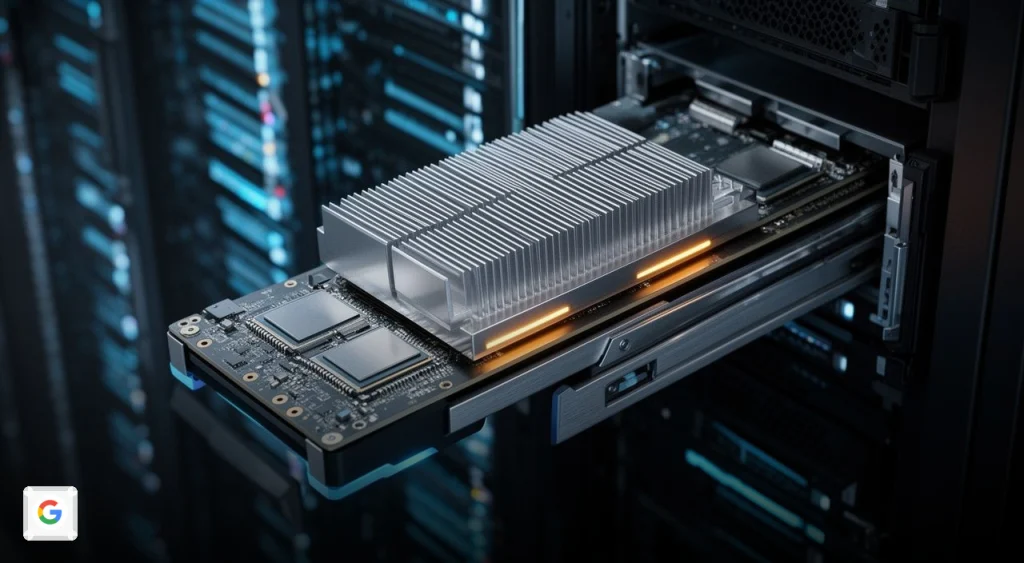
The TPU 8i Max focuses on memory density. By packing two chips into one package, it delivers the highest compute density per rack in the lineup. This configuration is specifically engineered to manage the massive context windows that modern AI agents require to reason across large datasets and execute multi-step tasks without losing context.
Why is Google releasing four TPU systems in a single year?
Google is accelerating its hardware release cadence because the transition from human-scale computing to autonomous agent operations requires specialized infrastructure. While chip design takes years, the modular AI Hypercomputer architecture allows the company to rapidly adjust packaging, memory, and networking around existing silicon to meet emerging bottlenecks in agentic AI and regulated industries.
Historically, designing a new chip involves a multi-year process bound by the laws of physics. However, designing a system—how compute, networking, and storage are brought together around the chip—can be done much faster. Google introduced the TPU 8t for training and TPU 8i for real-time reasoning in April 2026. The addition of the 8tx and 8i Max marks the first time the company has introduced four TPU systems in a single calendar year.
"The infrastructure demands of AI agents are forcing hardware innovation." — The Tech Buzz
This rapid iteration is a direct response to customer feedback. As businesses move beyond simple prompts to deploying autonomous agents, they need accelerators that can process vast amounts of information simultaneously, especially with "computing moving from human to agent scale." Furthermore, highly regulated industries require specialized encryption capabilities that standard cloud infrastructure cannot always provide.
How will TPU 8tx and 8i Max affect enterprise AI buyers?
For IT decision-makers and business owners, the new Google TPU systems lower the barrier to deploying highly regulated AI applications and complex multi-step agents without compromising data privacy or hitting memory limits. The shift toward confidential computing and expanded context windows directly addresses the primary technical blockers preventing widespread enterprise adoption of autonomous AI workflows.
For a financial institution or healthcare provider, the TPU 8tx means they can fine-tune and run AI models on private, sensitive data without exposing it to the underlying cloud infrastructure. The system also borrows the Boardfly network from the TPU 8i, delivering up to 2x lower latency than the TPU 8t with a near-zero performance penalty from the security encryption.
For software development teams building agentic workflows, the TPU 8i Max solves the context window bottleneck. Agents can now ingest entire codebases, lengthy legal contracts, or massive historical datasets in a single pass, allowing them to reason and act independently over long horizons. Google is also supporting these systems with an open software stack, including native PyTorch support, to make the hardware accessible to a broader range of developers.
When can customers access the new Google TPU hardware?
Google Cloud customers can expect to access the new TPU 8tx and TPU 8i Max systems starting in 2027, as the company transitions these specialized hardware configurations from announcement to general availability. The expanded eighth-generation portfolio, which now includes the 8t, 8i, 8tx, and 8i Max, currently serves nearly 100 enterprise customers.
The TPU business has grown to include a diverse set of clients, ranging from frontier AI research labs and trading firms to retailers and universities. These organizations are increasingly deploying TPUs not just in Google’s cloud, but directly into their own data centers for specific workloads.
The 2027 availability timeline gives enterprise IT teams a window to evaluate how confidential computing and expanded context windows will integrate into their existing AI strategies. As the agentic AI era matures, the ability to securely process massive amounts of data in memory will dictate which organizations can successfully scale autonomous workflows.