
AI Vendor Risk: How to Read Funding, Revenue, and Red Flags Before You Buy
Evaluating an AI vendor requires looking beyond standard security questionnaires to assess financial runway, model dependencies, and data governance. This guide explains how to read funding metrics, identify supply chain red flags, and secure contractual protections to ensure your AI tools remain operational and compliant.
Key Financial Metrics for Evaluating AI Startups
| Financial Component | Monthly Figure | Cumulative Impact |
|---|---|---|
| Gross burn | $150,000 | Total monthly cash outflows for salaries, compute, and infrastructure |
| Monthly revenue | $50,000 | Incoming cash from existing subscriptions |
| Net burn | $100,000 | Gross burn minus monthly revenue |
| Cash reserves | $1,500,000 | Total available capital in the bank |
| Derived Runway | 15 months | Cash reserves divided by net burn rate |
This brings the total available runway to 15 months, assuming no changes in revenue or spending.
What is AI vendor risk and why does it need its own review?
AI vendor risk encompasses the unique exposures introduced when a supplier uses artificial intelligence, including hidden model dependencies, unpredictable outputs, and the potential for your data to train third-party systems. Standard third-party risk management processes often miss these nuances because they focus on traditional software security rather than AI-specific behaviors.
OneTrust notes that the shift to third-party AI solutions necessitates a fundamental transformation in how companies assess and manage risks. PwC adds that traditional vendor management tools were not built to address challenges like model training, bias mitigation, or data lineage controls. Panorays explains that AI adds three exposures a traditional questionnaire rarely reaches: your data may be retained to train models, the vendor may depend on model providers you never assessed, and the output itself can be inaccurate or manipulated. The October 2026 Cursor Marketplace attack, which compromised the Claude Code extension and affected up to 5,000 installs, demonstrates how trusted distribution channels can introduce hidden supply chain risks. Safe Security, citing FAIR Institute guidance, notes that shadow AI emerges when departments adopt tools without central oversight, so none of it goes through vendor intake.
How to evaluate an AI vendor’s financial health and runway
Tech World News
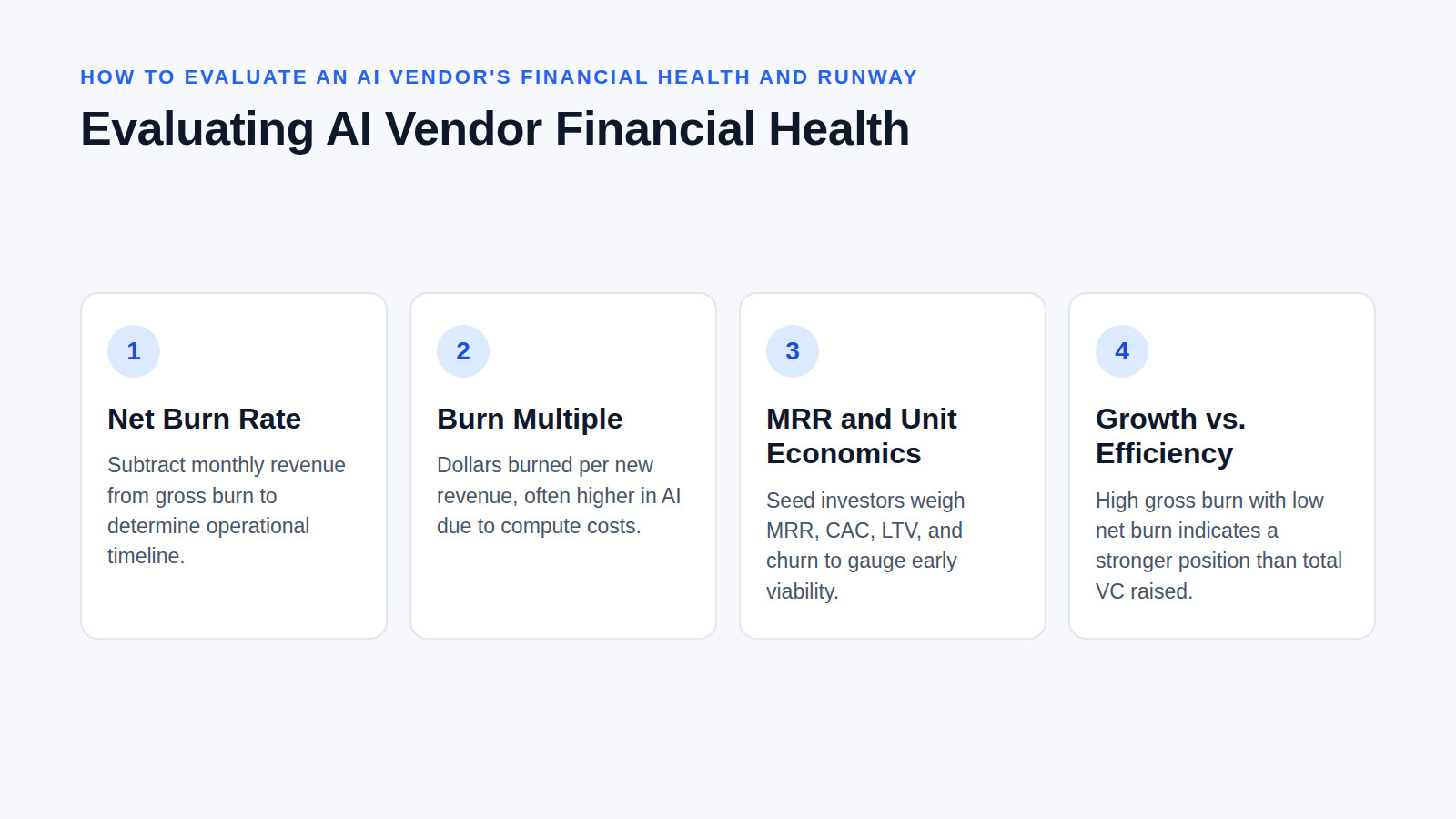
Assessing an AI vendor’s financial survival requires analyzing their net burn rate, burn multiple, and monthly recurring revenue rather than relying solely on total venture capital raised. Investors evaluate scalability through growth rate and revenue quality, meaning a vendor with high gross burn but low net burn is in a stronger position.
According to DealPotential’s analysis of startup runway, net burn is calculated by subtracting monthly revenue from gross burn, which directly determines the vendor’s operational timeline. In the current market, the median Series B company increased burn by only about 8% year-over-year in 2024, reflecting investor demands for capital efficiency. However, in AI-powered startups, the burn multiple—dollars burned per dollar of new revenue—skews higher due to expensive compute costs. As CRV explains regarding scalability, at the seed stage, investors weigh monthly recurring revenue (MRR) to track growth consistency, customer acquisition cost (CAC) and lifetime value (LTV) to gauge early unit economics, and churn to measure retention. Connecting financial runway to technical debt reveals that a vendor with high compute costs and frequent model swaps is a dual risk; if they cannot demonstrate a clear path to lowering their burn multiple, their long-term viability is at risk.
What red flags indicate a hidden supply chain or model dependency?
Tech World News
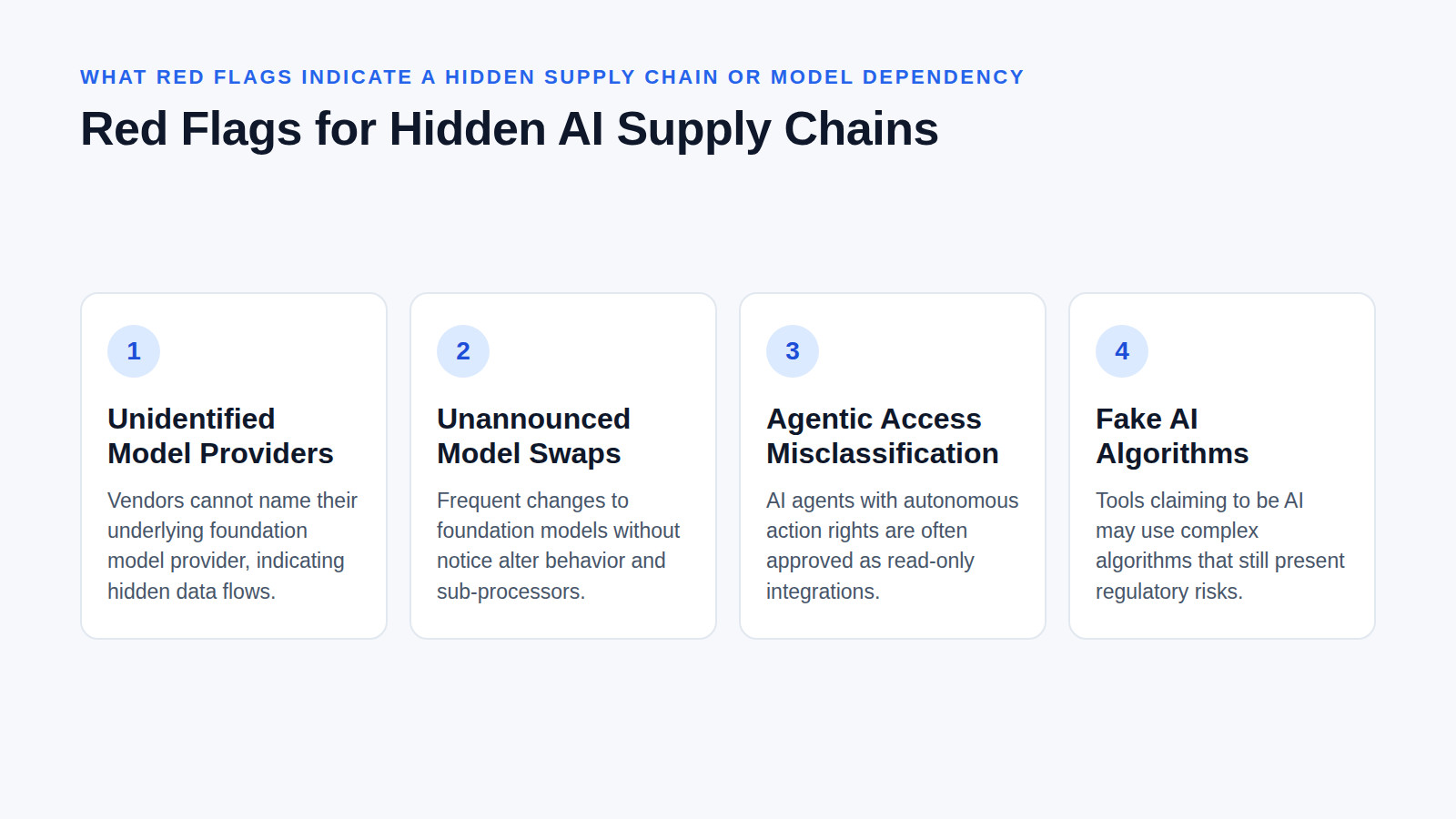
Red flags include a vendor’s inability to name their underlying foundation model provider, frequent unannounced model swaps, and the use of agentic access that operates beyond read-only integrations. These indicators suggest your data is passing through a hidden supply chain you have not vetted or approved for your specific compliance requirements.
As Safe Security points out, the real exposure often sits one layer down: many AI tools call a third-party model API, so your data may pass through a model provider you have no contract with and never assessed. When a vendor updates or swaps foundation models without notice, it changes behavior, data flows, and sub-processors. Safe Security also warns that many reviews treat an AI agent as just another integration and approve broad OAuth scopes up front, even though an agent can send email, modify tickets, merge code, or call internal APIs. Furthermore, Compliance Edu emphasizes that "not everything that claims to be AI really is AI", so ask each vendor what the tool actually does rather than trusting the label. Some organizations now use tools that analyze DNS traffic and web data to flag potential hidden AI use, as traditional intake processes fail to capture these dependencies.
How to protect your data and workflows in the contract
Tech World News
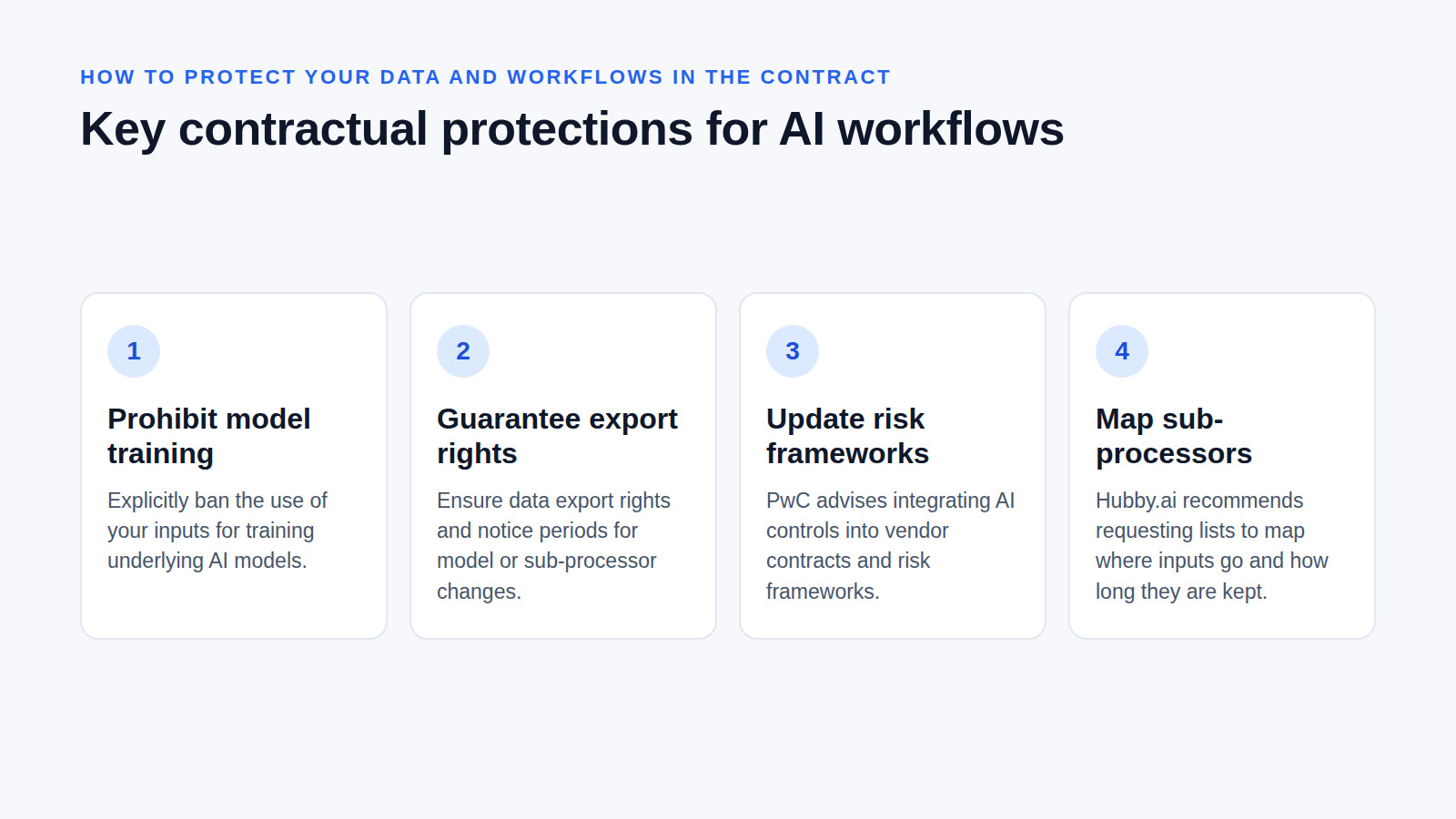
Contractual protections must explicitly prohibit the use of your inputs for model training, guarantee data export rights, and mandate notice periods for any changes to underlying AI models or sub-processors. Relying on a vendor’s standard terms of service is insufficient for enterprise AI governance and regulatory compliance.
PwC advises that organizations must go beyond checkbox diligence by updating vendor contracts and integrating AI-oriented controls into their risk frameworks. Debevoise notes that firms must decide how to mitigate risks through contractual conditions, especially given regulatory scrutiny over the outsourcing of functions.
Due diligence should be reasonably tailored to the identified service provider and to the functions or services to be outsourced. — Debevoise
Safe Security recommends asking for the list of model providers and other AI sub-processors, with advance notice before any change, and finding out how long prompts are kept upstream. If a vendor refuses to share model details or guarantee an opt-out for training data, the risk profile may be unacceptable for confidential workloads.
What steps to take if your AI vendor shuts down or gets acquired
If an AI vendor shuts down or is acquired, you must immediately enforce data export clauses, transition to a backup provider, and audit the new parent company’s AI governance policies. Proactive contingency planning prevents operational paralysis when a vendor’s corporate status changes unexpectedly.
OneTrust emphasizes the need for a holistic approach to vendor assessment that includes managing third-party risk to build trust and ensure continuity. When a vendor is acquired, the new parent company may have different data retention policies or use different foundation models, altering the risk profile you originally approved. Maintaining local backups of critical AI-generated outputs and keeping a mapped list of alternative providers ensures you are not locked into a single point of failure. Regularly testing your data export functionality guarantees that you can retrieve your workflows without relying on the vendor’s ongoing cooperation.
Pre-Signing AI Vendor Checklist
- Verify net burn rate and request the latest burn multiple to confirm financial runway.
- Demand a complete sub-processor list, including all underlying foundation model providers.
- Contractually prohibit the use of your inputs for model training.
- Require a 90-day notice period for any changes to underlying AI models or sub-processors.
- Test data export functionality in a trial environment before signing the final agreement.
Frequently asked questions
What is AI vendor risk assessment and what does it include?
An AI vendor risk assessment examines how a supplier builds, uses, and governs artificial intelligence inside the service you buy. It extends standard security reviews to cover data use, model sourcing, output reliability, and the hidden supply chain of underlying foundation models.
What are 5 risks of AI?
The five primary risks of AI include your data being used to train external models, outputs being inaccurate or manipulated, hidden supply chain dependencies, shadow AI adoption without oversight, and agentic systems taking unauthorized autonomous actions inside your internal networks.
What are some examples of vendor risk?
Concrete examples of vendor risk include the October 2026 Cursor Marketplace attack that compromised a trusted coding extension, unannounced foundation model swaps that alter data flows, and employees using unapproved browser extensions that read every single page they visit.
Reviewed by Shahid Anwer · Editorial standards