
AWS Launches Open-Source Physical AI Toolchain to Accelerate Industrial Robotics
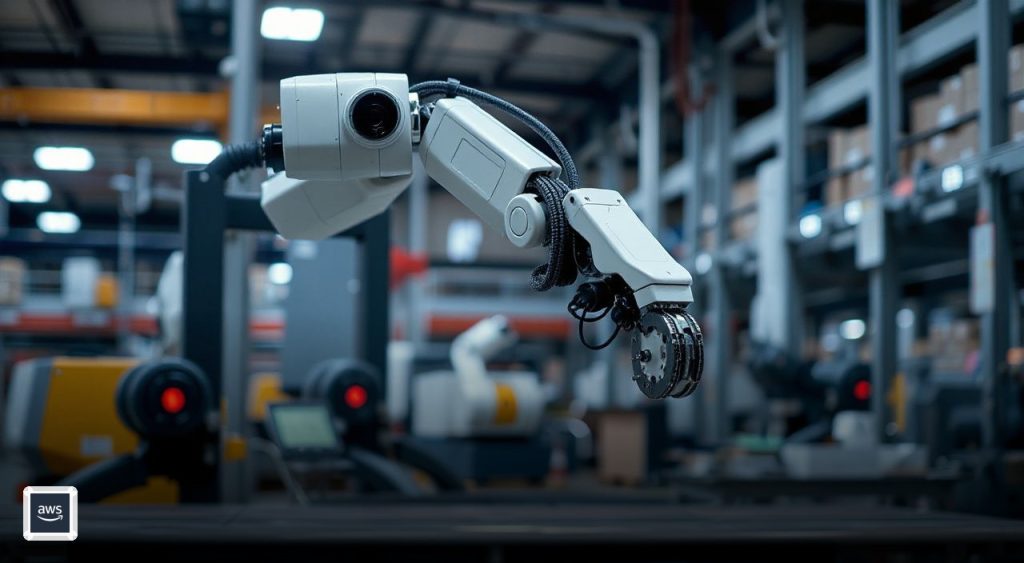
Amazon Web Services (AWS) has introduced an open-source Physical AI Toolchain integrated with NVIDIA technology to help manufacturers develop, simulate, and deploy intelligent robots. The platform automates infrastructure and provides reference architectures across the entire robotics lifecycle, aiming to reduce deployment timelines from years to weeks by shifting engineering focus away from底层 infrastructure and toward core innovation.
What Does the AWS Physical AI Toolchain Actually Do?
Unlike traditional software development, building physically intelligent machines requires managing a complex pipeline that bridges digital models and real-world physics. The new toolchain addresses this by covering the five stages of Physical AI development: synthetic data generation, model training, simulation and validation, edge deployment, and continuous improvement.
The platform is designed to be both robot-agnostic and task-agnostic. Developers can bring their own Unified Robot Description Format (URDF) files, teleoperation data, and specific task definitions, while the underlying infrastructure handles the heavy lifting of compute provisioning and pipeline orchestration. This modular approach allows teams to generate simulated training environments, train robots using human demonstrations, and test machine behavior in virtual scenarios before deploying the models to physical equipment.
Once a machine is deployed, the system does not remain static. Operational data flows back to the cloud to continuously retrain and improve the models. This closed-loop architecture ensures that machines adapt to new parts, handle unpredictable environments, and increase their precision over time without requiring manual reprogramming for every new variable.
Why Did AWS Build a Dedicated Toolchain for Physical AI Now?
The timing of this release addresses a specific bottleneck in the robotics industry: the massive engineering overhead required to move a robot from a working lab prototype to a reliable production system. Getting a physical AI system to market requires an integrated pipeline spanning data collection, synthetic data generation, model training, simulation-based validation, and edge deployment. Each stage demands different compute resources, specialized tools, and distinct operational constraints. Historically, the handoffs between these stages have caused development teams to lose months of engineering time.
Physical AI is going to touch every industry that moves, builds, or makes things, and our customers are moving fast to capture that opportunity. We built the Physical AI Toolchain on AWS because customers told us that too much of their engineering effort was going to infrastructure instead of innovation. We want to flip that. — Uwem Ukpong, Vice President of AWS Industries
Beyond resolving the engineering bottleneck, AWS is capitalizing on the "flywheel" effect inherent in physical AI. As AWS executive Steve explained, physical AI is not a linear pipeline but a continuous loop where “deployed robots generate new data that reveals gaps in their training”. Those gaps inform new simulation scenarios, which in turn require fresh synthetic training data.
AWS is drawing directly on its own operational experience to inform this toolchain. The company has already “deployed more than one million robots” across its internal logistics and fulfillment operations. The lessons learned from managing a fleet of that scale—specifically regarding how machines fail, how data degrades, and how edge environments vary—are baked into the reference architectures provided to external developers.
How Are Startups Using AWS to Build Humanoid and Dexterous Robots?
The toolchain is already being utilized by a growing ecosystem of startups tackling some of the most difficult problems in robotics, ranging from cognitive humanoids to dexterous manipulation. According to the Global Startup Trends Report on physical AI, one in seven startups globally is now building physical AI, with 72% of those builders stating that cloud computing is essential to their systems.
NEURA Robotics is using the infrastructure to develop cognitive humanoid robots capable of seeing, hearing, and learning from experience. The company aims to bring millions of intelligent robots to market by 2030. David Reger, founder and CEO of NEURA Robotics, highlighted the importance of accelerated deployment cycles, noting, "In Physical AI, speed is everything: how fast you can fine-tune models, deploy them into the real world and scale from individual systems to large fleets".
Other startups are focusing on highly specialized mechanical challenges. RLWRLD is addressing dexterous manipulation by building an 8.1-billion-parameter foundation model designed to give robotic hands the ability to grasp, rotate, and handle objects with human-like precision across both factory and service environments.
Data scarcity is another major hurdle in robotics, which Config is attempting to solve. The company has built a data pipeline capturing more than 200,000 hours of robot action data. Config uses generative AI to multiply this baseline data into the diverse training scenarios machines need to operate reliably in unpredictable, real-world conditions.
What Does Physical AI Mean for Enterprise Manufacturers and the Broader Industry?
For enterprise practitioners, the introduction of a standardized, open-source toolchain signals a shift from static automation to adaptive, continuous learning systems. Traditional industrial machines follow fixed instructions and repeat the same task regardless of environmental changes. Physical AI enables machines to perceive their surroundings, reason using cloud-trained models, and adapt in real time.
The enterprise demand for this capability is already substantial. According to the Capgemini Research Institute, “79% of organizations are already engaging with Physical AI”, and 60% of executives believe the technology will enable robotics adoption in areas that were once impossible or impractical. Manufacturers can use these tools to build collaborative robot arms that adapt to new assembly tasks on the fly, while automakers can accelerate the development of in-vehicle and in-plant robotics capabilities.
Crucially, the modular nature of the AWS toolchain prevents the monolithic lock-in that has historically slowed enterprise technology adoption. Because the architecture is open-source and robot-agnostic, manufacturers can integrate it with their existing hardware and software stacks. AWS can also add new tools to the toolchain over time, ensuring that the infrastructure evolves alongside advancements in foundation models and edge compute hardware.
The transition from pre-programmed repetition to real-time environmental adaptation represents a fundamental change in how factories and logistics networks operate. By providing the underlying infrastructure to manage the entire physical AI lifecycle, AWS is enabling enterprises to treat robot fleets not as fixed capital equipment, but as continuously improving software-defined assets.
Related articles


