
Enterprise AI Market Share: OpenAI vs Anthropic vs Google for Business Buyers
Anthropic has overtaken OpenAI in enterprise API spend and coding workloads, while OpenAI retains the lead in overall production usage among large enterprises, and Google leads in long-context and integrated workspace deployments. This guide breaks down the enterprise AI market share, pricing, and use-case specialization to help IT decision-makers choose the right foundation models for their operations.
Key Enterprise AI Market Figures
| Metric | Figure | Source & Date |
|---|---|---|
| Enterprise AI Market Size (2026) | projected at $42.0 billion by Grand View; estimated at $114.87 billion by Mordor | 2024 / Sep 2026 |
| Enterprise LLM API Spend Share | Anthropic 55%, OpenAI 31% | Nov 2026 |
| Enterprise LLM Usage Share | Anthropic 32%, OpenAI 25%, Google 20% | Nov 2026 |
| Business AI Adoption Rate | Anthropic 44.8%, OpenAI 40.6% | Oct 2026 |
| Coding Market Share | Anthropic 54%, OpenAI 21% | Dec 2025 |
What Is the Current Enterprise AI Market Share Among the Big Three?
Anthropic currently leads enterprise AI API spend and coding workloads, capturing 55% of API spend, while OpenAI maintains the highest overall production usage among large enterprises at 78%, and Google holds a 20% share of general enterprise usage with strength in integrated deployments.
The shift in API spend marks a significant change from late 2023, when OpenAI commanded roughly half of the enterprise large language model market. Today, Anthropic captures 32% of overall enterprise usage, ahead of OpenAI at 25% and Google at 20%. This usage data reflects a broader trend where businesses are diversifying their model providers rather than relying on a single vendor for all text generation tasks.
Despite Anthropic’s lead in API spend and developer tooling, OpenAI remains the dominant choice for broad, company-wide deployment. An a16z survey of 100 Global 2000 CIOs found that 78% of surveyed enterprise leaders are using OpenAI models in production, either hosted directly or via cloud services. Meanwhile, the Ramp AI Index shows that across all business sizes, Anthropic adoption sits at 44.8% compared to OpenAI at 40.6%, indicating that Anthropic is winning the battle for individual developer and technical team wallets.
Why Do Enterprise AI Market Size Forecasts Disagree So Widely?
Tech World News
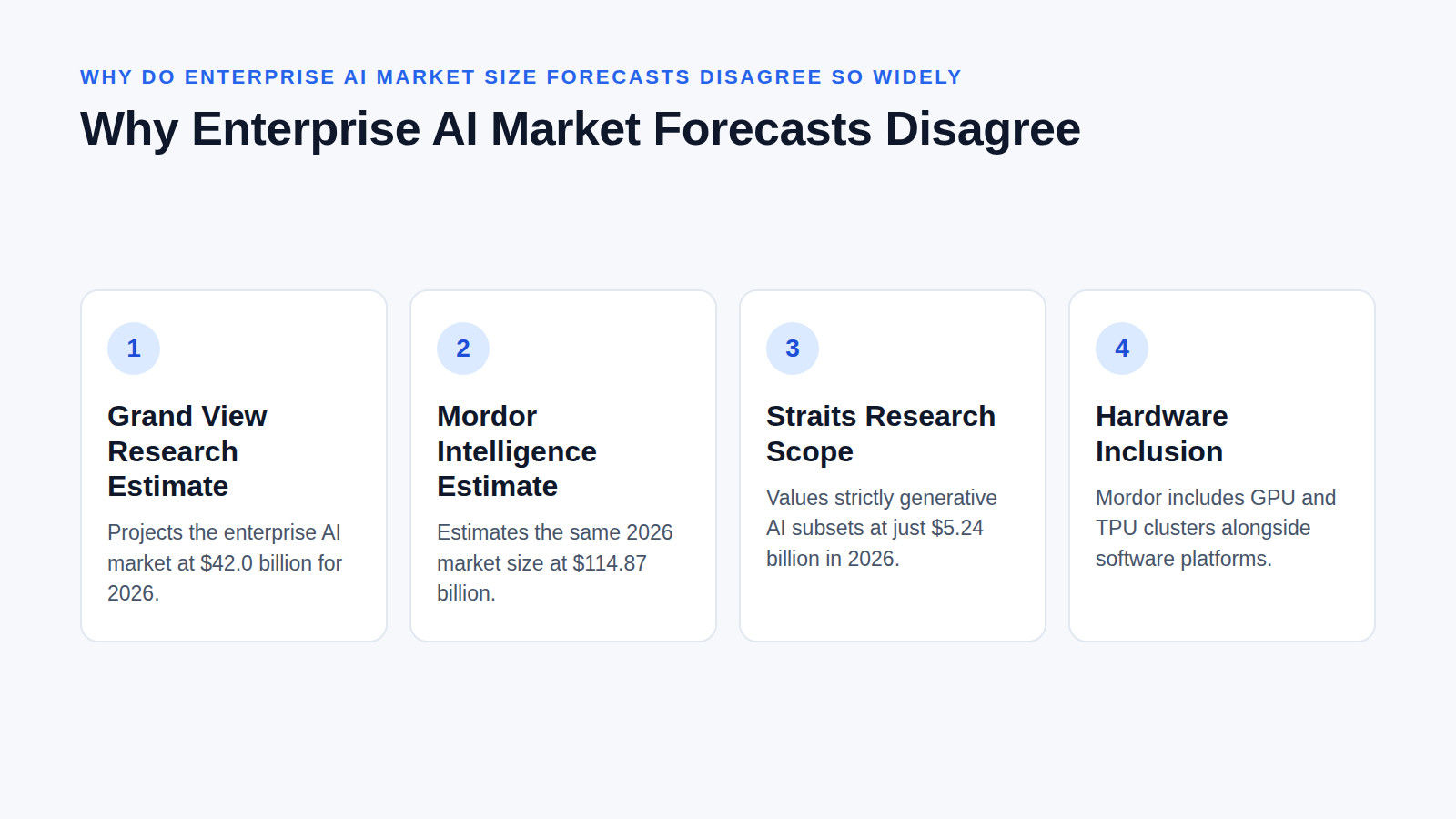
Market research firms define the enterprise AI market differently, leading to massive discrepancies in total addressable market estimates for 2026, with Grand View Research projecting $42.0 billion while Mordor Intelligence estimates $114.87 billion for the exact same calendar year.
Grand View Research values the global enterprise AI market at $23.9 billion in 2024, projecting it to grow to $42.0 billion in 2026 at a 37.6% compound annual growth rate. In stark contrast, Mordor Intelligence estimates the market size stood at $114.87 billion in 2026, projecting it to reach $273.08 billion by 2031.
The variation stems from how each firm categorizes AI spending. Straits Research, which measures only enterprise generative AI, values that subset at about $5.25 billion in 2026. Mordor Intelligence’s larger figure includes hardware accelerators, such as GPU and TPU clusters, alongside software platforms and services. For business buyers evaluating vendor contracts, total market size is less actionable than vendor-specific spend shares and token pricing, which directly impact operational budgets.
How Do OpenAI, Anthropic, and Google Specialize for Business Use Cases?
Tech World News
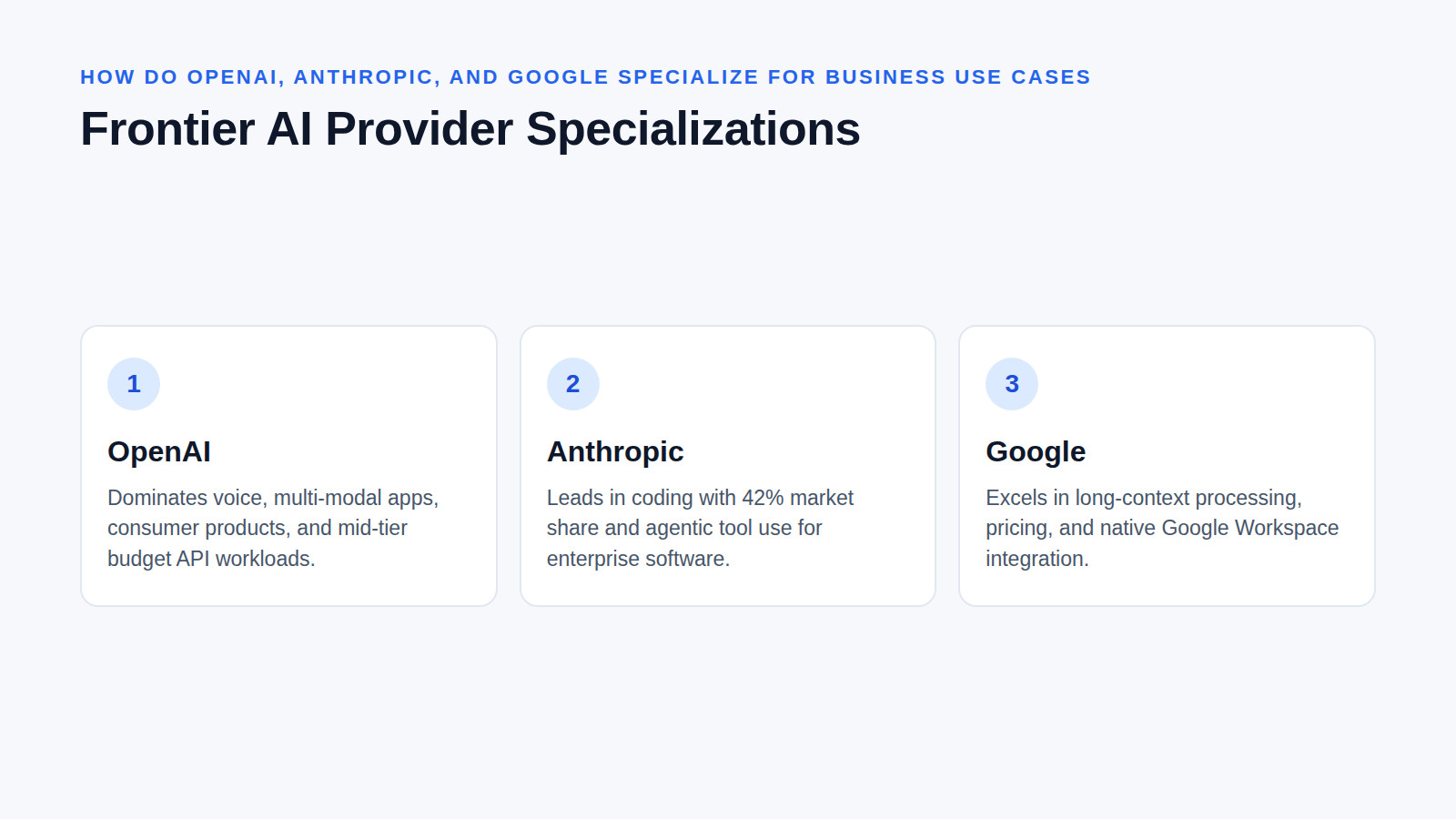
The three frontier providers have specialized into distinct categories: OpenAI dominates voice and multi-modal applications, Anthropic leads in coding and agentic tool use, and Google excels in long-context processing and native workspace integration for enterprise teams across different departments.
OpenAI is the stronger choice for consumer-facing products, broad employee adoption of a familiar chat app, and budget API workloads at the mid tier. Anthropic is the stronger choice for enterprise software work, coding, and long-running AI agents. As one industry analysis noted, "For two years, AI buyers asked ‘which model is best?’ In late 2025, the honest answer became: it depends what you are doing". Claude quickly became developers’ top choice for code generation: by December 2025, Menlo Ventures put Anthropic’s share of the coding market at 54%, more than double OpenAI’s 21%.
Google dominates long-context processing, price, and native Google Workspace integration. Gemini is built to work across text, images, video and documents in a single request, which suits tasks such as reviewing video footage or checking scanned documents alongside written records. This specialization means no single model wins every category, forcing businesses to align their vendor choices with specific departmental workflows.
What Are the Real Costs of Deploying These Models at Scale?
Tech World News
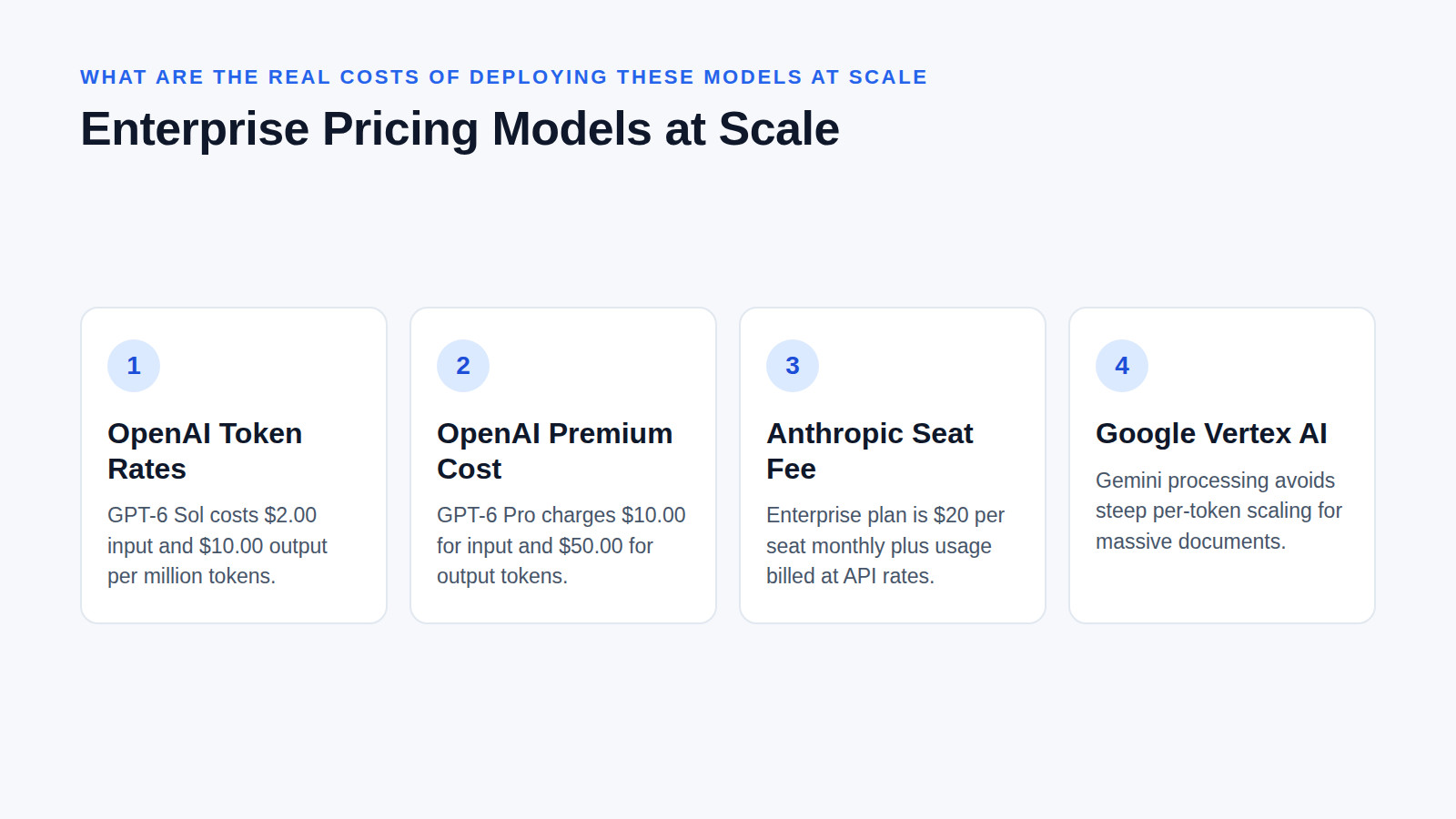
Enterprise pricing varies significantly by model tier and deployment method, with OpenAI charging per million tokens for its GPT-6 series, Anthropic billing a $20 per seat monthly fee plus API usage for Enterprise, and Google offering competitive scaling through Vertex AI.
OpenAI’s enterprise token-based pricing lists the standard GPT-6 Sol model at $2.00 per million input tokens and $10.00 for output, while the premium GPT-6 Pro costs $10.00 for input and $50.00 for output. These rates apply to eligible token-based Enterprise agreements, replacing older message-based billing models to standardize costs across all product surfaces.
Anthropic’s Enterprise plan is built for large businesses operating at scale, priced at “$20 per seat per month plus usage billed at API rates”. This structure ensures that costs scale directly with the models and tasks the team runs, including advanced security and admin controls like SCIM and audit logs. Google Cloud’s Vertex AI enables businesses to roll out agents faster, leveraging Gemini’s long-context capabilities to process massive documents without the per-token costs scaling as steeply for large inputs, making it highly cost-effective for data-heavy industries like legal and finance.
How Should Businesses Build a Multi-Model AI Strategy?
Smart businesses route different workloads to different providers to optimize for cost, quality, and reliability, rather than depending on a single foundation-model vendor for all enterprise AI tasks and workflows across their entire organization.
Relying on a single provider introduces vendor lock-in and exposes the business to model-specific downtime or price hikes. Enterprises are increasingly embracing multi-AI approaches, using gateways like Databricks Unity Gateway to manage and route traffic across multiple proprietary and open-weight models. Databricks notes that AI model preferences are changing faster than ever, and the highest-performing AI model is rarely the best value for every specific task.
What to watch for: As Menlo Ventures reports, agents now generate 80% of all tokens on OpenRouter, roughly seven times human-driven usage, so token consumption climbs quickly as workflows become automated. IT leaders must watch for automated coding and data-processing agents driving API costs past initial budgets, necessitating strict routing logic that defaults cheaper models for background tasks and reserves premium models for final output verification.
Practical Multi-Model Routing Checklist
- Use Anthropic for coding agents, complex software engineering tasks, and long technical document review.
- Use OpenAI for voice interfaces, multi-modal tasks, and general employee chatbots requiring broad familiarity.
- Use Google for massive context windows, video analysis, and native Workspace integrations.
- Implement an AI gateway to route workloads dynamically, manage fallbacks, and enforce strict token spend limits.
Frequently asked questions
Who is leading in enterprise AI?
Anthropic leads in enterprise API spend and coding workloads, capturing 55% of API spend, while OpenAI leads in overall production usage among large enterprises, with 78% of surveyed Global 2000 CIOs using its models in active production.
Menlo Ventures reports Anthropic takes 55% of enterprise LLM API spend compared to OpenAI’s 31%. However, an a16z survey shows OpenAI remains the clear enterprise leader for overall production deployment, with the firm noting that "the market is too dynamic to crown a single, durable winner".
How big is the enterprise AI market?
The enterprise AI market size varies by research firm, with Grand View Research projecting $42.0 billion in 2026 and Mordor Intelligence estimating $114.87 billion for the same year, reflecting different definitions of what actually constitutes the enterprise AI market.
Grand View Research focuses on core AI software and services, projecting $42.0 billion in 2026. Mordor Intelligence includes hardware accelerators and broader platform deployments, arriving at $114.87 billion. Buyers should focus on vendor-specific spend shares rather than total market size when making procurement decisions.
Which AI has the most market share?
Anthropic holds the largest share of enterprise LLM API spend at 55% and overall usage at 32%, while OpenAI follows with 25% usage share and Google holds 20% of the general enterprise usage market today.
In coding, Menlo Ventures estimated in December 2025 that Anthropic held 54% of the market against OpenAI’s 21%. By its 2026 report, coding had grown into a $34.0 billion market, with Claude Code and OpenAI’s Codex together taking 70% of it.
What are the top enterprise AI platforms?
The top enterprise AI platforms are OpenAI’s API and ChatGPT Enterprise, Anthropic’s Claude Enterprise and API, and Google’s Vertex AI, each serving distinct workloads ranging from agentic coding to long-context document analysis for business users.
Businesses increasingly use centralized gateways to manage and route traffic across these multiple proprietary models, ensuring they can leverage the specific strengths of each platform while maintaining strict security and compliance controls.